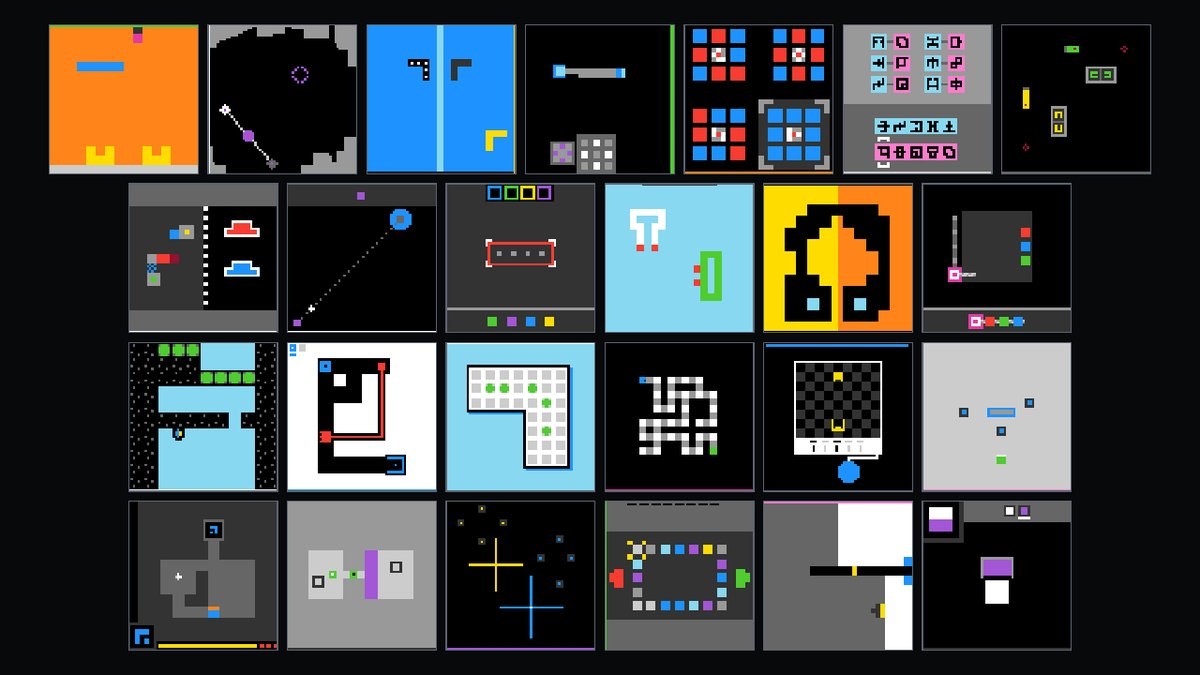
Interactive reasoning benchmarks have evolved past the point where static prompt engineering or brute-force memorization can fake competence. The frontier has shifted to exploratory execution: testing whether an autonomous agent can systematically navigate unfamiliar runtime environments via trial and error without handcrafted guidance. On August 21, 2026, NVIDIA posted a 100% sweep on the ARC-AGI-3 benchmark with its general-purpose coding agent, NVIDIA AVO, setting a new high-water mark for autonomous tool use while reigniting standard industry skepticism over synthetic evaluation boundaries.
Perfect Run Across 25 Public Environments
NVIDIA AI reported that NVIDIA AVO solved all 183 levels across all 25 public ARC-AGI-3 environments. Crucially, the system tackled these interactive testbeds without pre-stated goals, explicit transition rules, or step-by-step guidance. Instead of resetting execution state across calls, AVO maintained stateful trajectories using dynamic environment feedback.
"NVIDIA AVO continuously inspects, plans, implements, and evaluates, using memory, tools, and execution feedback to build on what it learns along the way."
According to NVIDIA AI, the agent relies on an active loop combining persistent memory with runtime tool use. Rather than burning tokens on blind re-generation, the architecture inspects execution failures, revises its internal state representation, and iterates toward solutions—a baseline requirement for navigating complex enterprise software pipelines and undocumented legacy code.
Harness Architecture, Private Splits, and Enterprise Realities
Methodological scrutiny inevitably follows a flawless synthetic score. NVIDIA's technical disclosure indicates a split operational architecture: a task harness directs agent intent, while underlying infrastructure gates execution permissions. AI researchers and systems engineers quickly questioned whether the harness logic was disproportionately optimized for the 25 publicly visible environments, calling for unreleased private test suite evaluations to confirm true generalizability.
Beyond benchmark hygiene lies the core engineering tradeoff for engineering executives: inference cost versus real-world autonomy. While an iterative trial-and-error harness can crack synthetic game-like state machines, deploying closed-loop exploratory agents on mission-critical R&D tasks demands strict sandbox boundaries and predictable compute economics. If NVIDIA's iterative reasoning translates to unassisted bug triage across massive legacy repositories, AVO points toward a viable blueprint for enterprise R&D automation. Until private benchmark audits and compute metrics are disclosed, however, a 100% public run remains a promising demonstration of harness engineering rather than definitive proof of solved general reasoning.