AI · This text was generated with artificial intelligence
NVIDIA Cosmos 3 has arrived to finally dismantle the unstable clusters of models that currently prop up autonomous systems. While the industry has spent years trying to stitch together disparate neural networks for vision, logic, and motor skills, the June 1, 2026, release marks the end of the era of patchwork automation. This isn't just a cosmetic update to the stack; it is the launch of the first open World Foundation Model capable of processing environment generation, physical reasoning, and action control in a single forward pass. By moving away from "juggling" inference pipelines, Jensen Huang and his team are tackling the primary pain point of autonomous systems: latency and the compound error effect inevitable when passing data between a dozen different models.
From Pixels to the Laws of Physics
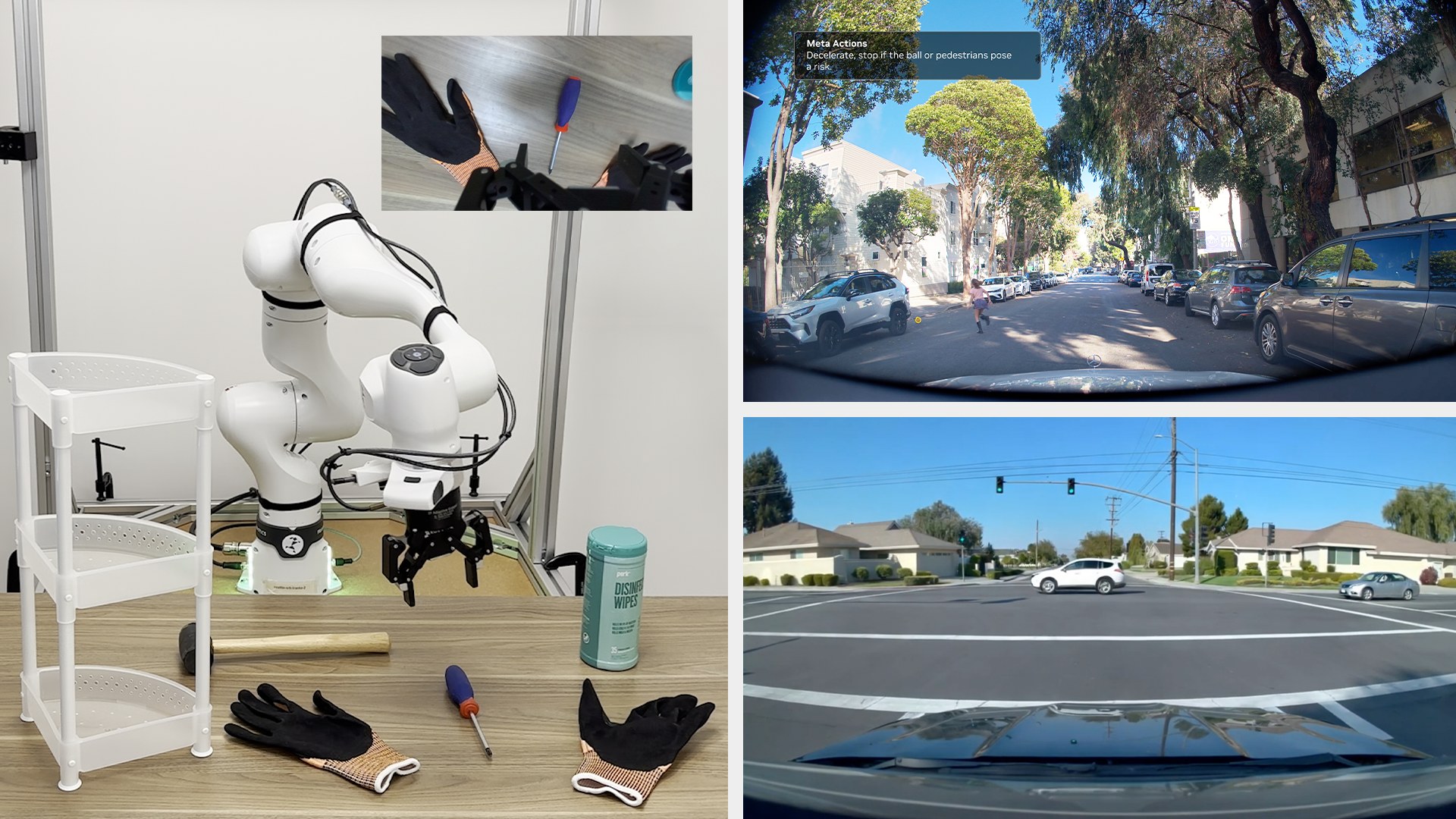
The real shift here lies in the transition from simple video generation to what NVIDIA calls "Physical AI." Previously, developers had to separately configure Cosmos Predict for visualization, Cosmos Reason for understanding, and Cosmos Policy for hardware control. Cosmos 3 collapses these into a unified Mixture-of-Transformers (MoT) architecture. It perceives text, images, audio, and physical commands as a single semantic space. The model understands cause-and-effect and spatial relationships rather than just guessing which pixel to draw next. Whether it's a robot folding laundry or a drone navigating a complex traffic situation, the system relies on a unified foundation.
"Cosmos 3 helps build Physical AI systems capable of understanding the real world—not just pixels and tokens, but motion, causality, physics, and action."
This architectural integrity means the same model functions as a Vision-Language Model (VLM), a dynamics model, and a robotic behavior strategy without changing its structure. For industrial automation, this is the path toward simulations where an understanding of gravity and object interaction is built-in by default. The model is released in two versions: Nano and Super, an apparent move to capture both ends of the market—enabling lightweight deployment on edge devices while maintaining heavy-duty computing in the cloud.
Open Weights as a Strategic Moat
By releasing Cosmos 3 on Hugging Face with open weights and fine-tuning scripts, NVIDIA is executing a calculated maneuver to seize control of the entire development stack for physical agents. This is a direct strike against closed ecosystems: the R&D entry barrier for mid-sized businesses is plummeting. Companies no longer need to pay for expensive proprietary model licenses; they can simply train Cosmos on their specific data. The package even includes datasets for Synthetic Data Generation (SDG). Such generosity incentivizes the robotics industry to standardize on NVIDIA’s framework, positioning the company as the default provider of "brains" for any new hardware.
Integration with Hugging Face and the publication of scripts on GitHub confirm that the battle for AI dominance has moved from the cloud to the factory floor. As these universal models take hold, the value of niche AI vendors will likely evaporate, giving way to comprehensive foundations that "think" before they act. CTOs should begin testing Cosmos 3 Nano on RTX workstations now. It is time to determine if architectural simplification justifies abandoning your legacy cascaded systems. The nvidia/Cosmos3-Nano repository is already live for benchmarking—an ideal opportunity to compare inference latency against your current multi-layered solutions.