AI · This text was generated with artificial intelligence
Surgical robotics is finally outgrowing its awkward phase of manual teleoperation, moving toward autonomous systems driven by Vision-Language-Action (VLA) policies. Until now, the industry faced a wall: training these systems in the physical world is a financial and logistical nightmare. High-end robotic platforms are prohibitively expensive, and every 'learning error' risks destroying precision instruments or irreplaceable biological samples. Traditional simulators, meanwhile, have been too rigid to handle the messy reality of the operating room—deformable tissues, smoke, and unpredictable fluid dynamics.
Generative Worlds Over Manual Modeling
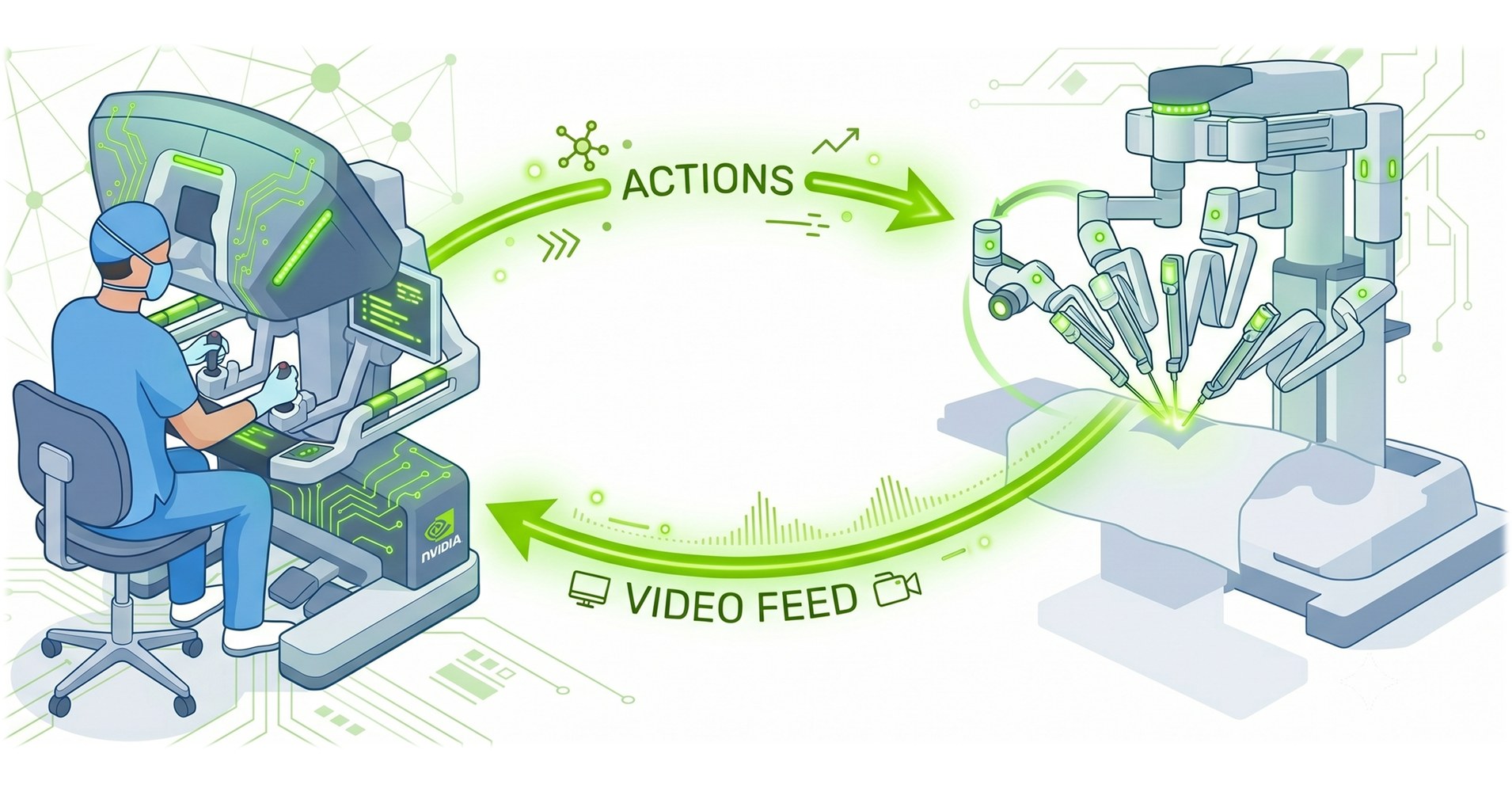
NVIDIA Cosmos-H-Dreams marks a departure from the labor-intensive era of manually authored physics. Instead of trying to code every physical rule by hand, these generative world models learn dynamics directly from video and robot kinematics. Built on the Cosmos-Predict2.5-2B architecture, this isn't just another synthetic data tool; it’s an action-conditioned, real-time simulator. While the earlier Cosmos-H-Surgical-Simulator was confined to offline batch generation, Cosmos-H-Dreams operates in a closed-loop autoregressive regime. In plain terms, it allows a VLA policy to 'hallucinate' a physically accurate surgical environment in response to its own actions, effectively solving the data scarcity problem without touching a single scalpel.
Cosmos-H-Dreams distills the capabilities of the massive Surgical-Simulator into a causal, few-step student model, served via the FlashDreams library to ensure the low-latency feedback required for surgical precision.
Running on a single NVIDIA RTX PRO 6000 GPU, the system demonstrates that interactive, high-fidelity environments for tasks like suturing are no longer the exclusive domain of massive server farms.
Distillation and the TCO of R&D
The real play here is economic. By utilizing a teacher-student training pipeline, NVIDIA has managed to slash the cost of generation without losing the nuance of surgical dynamics. The student model utilizes a streaming key/value cache, which is technical shorthand for saying it’s fast enough for real-time interaction. For MedTech firms, this translates to a radical reduction in Total Cost of Ownership (TCO) for R&D. Validating a new autonomous procedure used to mean months in physical labs; now, much of that burden moves into high-speed generative environments.
This shift fundamentally changes the competitive landscape of the industry. The strategic value is migrating away from proprietary hardware—which is becoming a commodity—toward the ownership of high-quality, synchronized video-action data. For CTOs and investors, the message is clear: the ability to fine-tune these world models with specialized clinical data will be the primary moat in the next decade of medical robotics. The Sim-to-Real gap hasn't vanished, but with Cosmos-H-Dreams, NVIDIA has built a much shorter bridge.