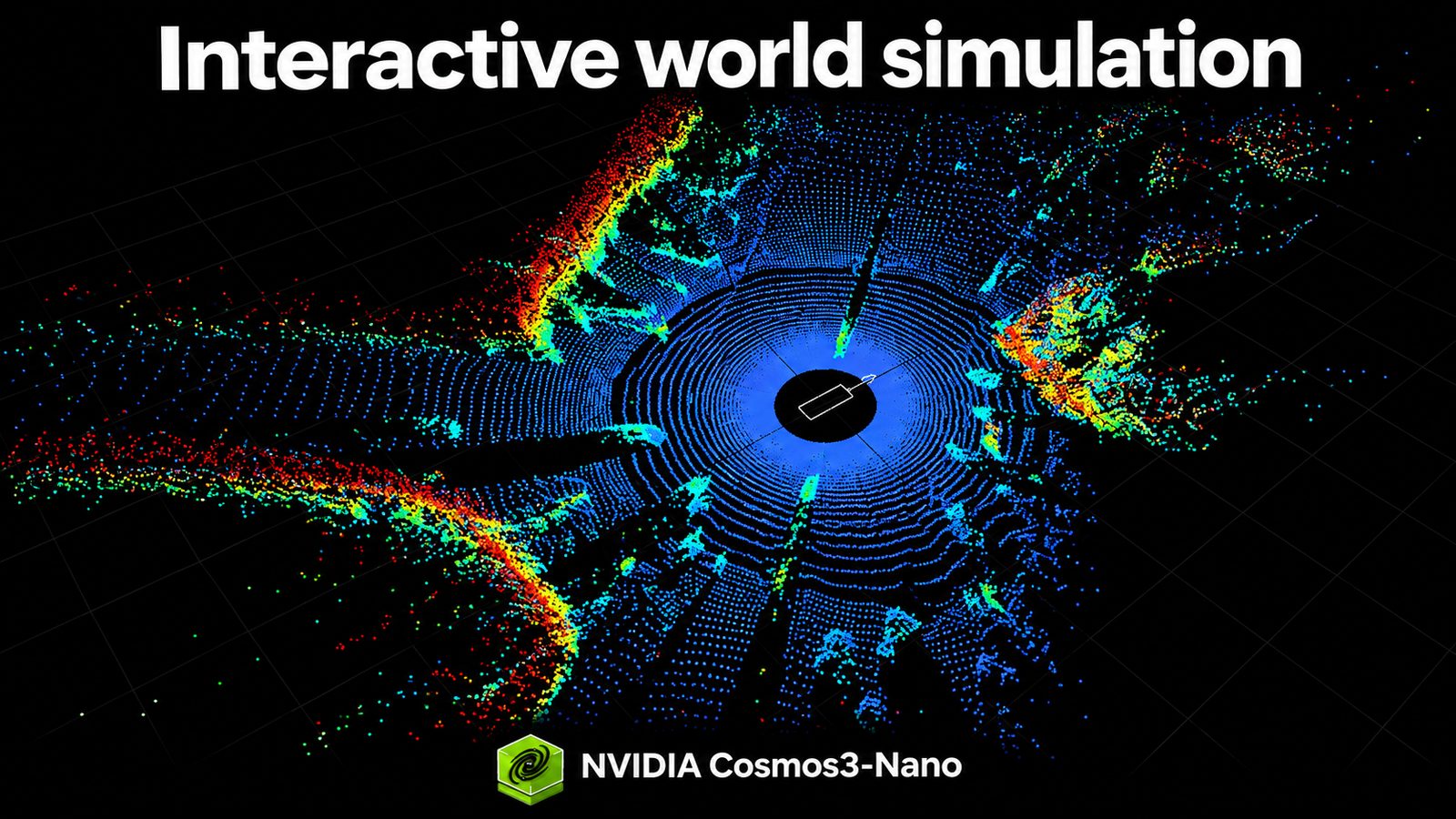
Can autonomous vehicle developers cut physical fleet testing budgets by using open-weight physical simulation models? As Nvidia demonstrates with the release of four new open-weight checkpoints to its Cosmos 3 model family, the reduction of physical testing overhead directly trades for enterprise compute cluster expenses. All four models are post-trained variants of Cosmos 3 Nano, featuring 16 billion trainable parameters each, designed to generate interactive world simulation and multi-sensor driving scenes.
Following the introduction of the Level 4 autonomy model Alpamayo 2 Super with 32 billion parameters as a teacher model processing multi-camera video feeds, Nvidia now provides generative physical simulators directly to development teams. All four models operate under the OpenMDW1.1 licensing framework, permitting commercial and non-commercial use without custom enterprise agreement negotiations, thereby shifting competition from costly real-world sensor data gathering to the operational cost of local model inference.
Synthetic Sensor Pipelines
The Cosmos3-Nano-Transfer-Auto checkpoint functions as a bidirectional model for offline synthetic driving data generation, producing synchronized video across up to 11 camera views, including fisheyes, alongside joint RGB–LiDAR generation. By generating multi-view driving data across varied weather, lighting, and time of day conditions, the model addresses the expensive collection cycles usually required to capture edge cases.
"The work ahead is to measure where the models faithfully support policy learning and evaluation, understand their limits, and improve where they fall short."
As Nvidia noted regarding deployment limits, researchers must establish where these synthetic observations reliably train real-world control systems. The causal variant, Cosmos3-Nano-Sim-Auto, acts as the distilled streaming counterpart to Transfer-Auto, generating successive small chunks of synchronized camera video and LiDAR in minimal denoising steps to interact with simulated policies in closed-loop systems.
Robotic Manipulation and Simulator Controls
Beyond autonomous driving, the release targets robotics runtime environments. Cosmos3-Nano-Sim-Transfer translates simulator controls and text prompts into photorealistic video, rendering color observations for policy consumption while keeping physics calculations inside the simulator. Meanwhile, Cosmos3-Nano-Sim-Bimanual predicts video output from robot or camera actions, simulating environmental evolution in response to bimanual robotic operations.
Teams integrating Cosmos 3 trade fleet operating costs for local inference hardware expenses. The open weights reduce upfront synthetic data licensing overhead, but production rollouts depend on whether distilled 16-billion-parameter checkpoints maintain simulation fidelity under live control loops, shifting autonomy budgets directly toward the infrastructure capacity required to run continuous multi-sensor streams.
How the picture shifted
Cutting physical fleet testing budgets immediately drives up local data center expenses after Nvidia made four fine-tuned Cosmos 3 Nano checkpoints openly available. While at the GTC 2025 conference Cosmos Transfer tackled robotic data scarcity with 7 billion parameters, each new checkpoint now demands running 16 billion parameters to synthesize synchronized camera and LiDAR streams. Nvidia itself acknowledges that teams still need to determine the reliable boundaries of using these synthetic feeds for training real-world control policies. Swapping asphalt testing for synthetic physics merely trades operational field expenses for server silicon bills while the boundary where simulated controls fail in the real world remains unproven.
Our stories: NVIDIA Cosmos 3: AI Models for the Physical World (June 1); NVIDIA Cosmos and GR00T: The New Era of Humanoid Robotics (June 26).