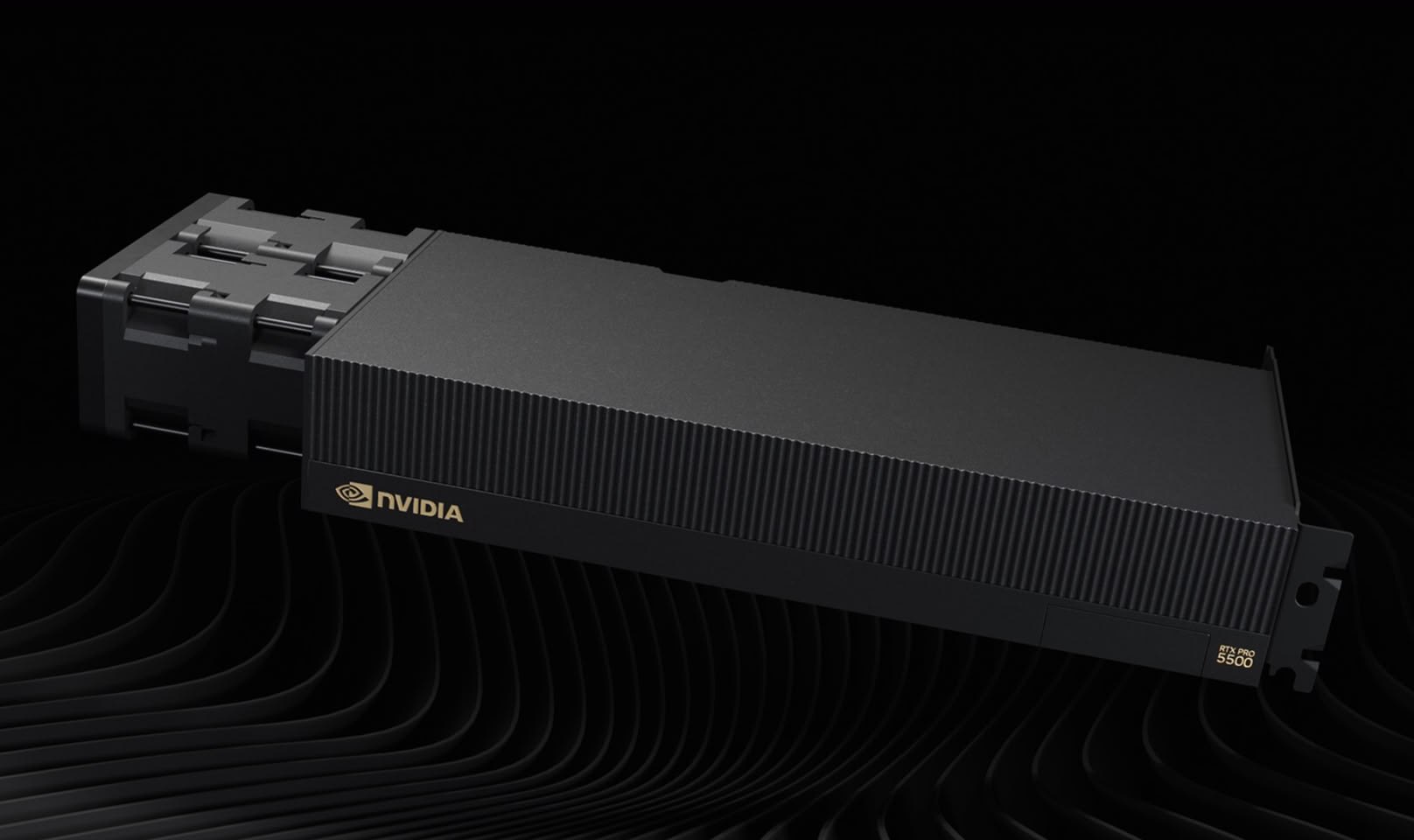
Nvidia has expanded its professional workstation lineup with the introduction of the RTX PRO 5500, built on the Blackwell architecture. The board packs a GB202 die featuring 21,760 CUDA cores and pairs it with 84 GB of GDDR7 memory.
To handle heavy data throughput, the 84 GB memory pool connects to the processor through a 416-bit memory bus, pushing roughly 1,398 GB/s of memory bandwidth. To squeeze 84 GB onto the board, Nvidia placed 14 GDDR7 modules on the front alongside the GPU die and another 14 modules on the back of the printed circuit board.
The 84 GB of GDDR7 is connected to the GB202 with a 416-bit memory bus that delivers about 1,398 GB/s of memory bandwidth.
This double-sided density arrangement packs the memory chips tightly without inflating the outer dimensions of the processor die. For enterprise infrastructure, this hardware signals a pragmatic pivot: shifting local inference and heavy model fine-tuning directly onto high-end workstations instead of burning capital on permanent cloud cluster rentals.
Lineup Positioning
Positioned just below the flagship RTX PRO 6000—which fields 24,064 CUDA cores and 96 GB of memory—the RTX PRO 5500 easily outpaces the RTX PRO 5000 Blackwell, which limits operators to 14,080 CUDA cores and up to 72 GB of memory. Nvidia pegs the thermal design power of the RTX PRO 5500 at 600 W, supporting multi-instance GPU partitioning for splitting the hardware into single 84 GB instances or dual 42 GB slices.
Official pricing and release dates remain absent from Nvidia's disclosures. Yet the strategic calculus for enterprise buyers is straightforward: local hardware ownership directly curbs cloud dependence when handling sensitive proprietary data and trims recurring R&D operational expenditures. Until the price tag drops, the exact ROI remains on paper, but the hardware blueprint for local enterprise AI nodes is crystallizing.