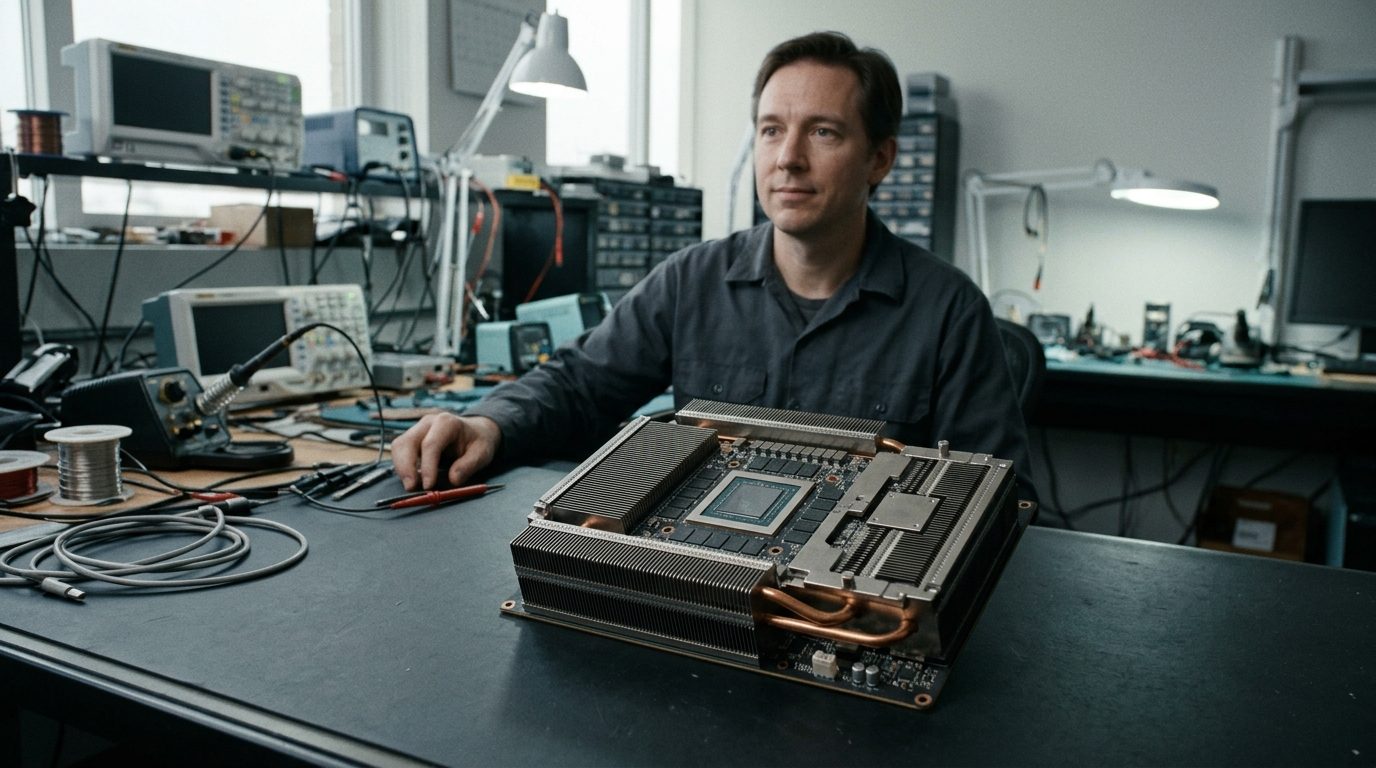
While marketing slides previously teased an accelerator boasting 1 TB of HBM4E memory, supply chain constraints held prototypes to 192 GB or 256 GB until Nvidia unveiled the Rubin HPC graphics processing unit on November 16, 2026, at the SC26 conference.
Nvidia is steering artificial intelligence beyond conversational chatbots toward heavy simulation workloads, targeting automated experimentation pipelines across enterprise research and development. Rubin HPC packs more than 50,000 CUDA cores on a single silicon die, incorporates seventh-generation NVLink, and anchors the Vera Rubin platform. For technology leaders holding multi-year CapEx budgets, this pivot introduces a stark financial calculus: can an enterprise justify heavy capital commitments toward agent-driven scientific workflows today when the required hardware deployment remains parked on a 2028 roadmap?
Solving Data Movement Bottlenecks
Many scientific computations process vast datasets by repeatedly pulling small, scattered fragments of information, causing processors to idle while waiting for memory transfers. According to Nvidia engineering disclosures, Rubin HPC addresses this bottleneck by focusing on high-bandwidth data movement alongside raw compute speed to keep its 50,000 CUDA cores continuously occupied.
Rubin HPC addresses memory bottlenecks with a balanced design that keeps CUDA cores busy.
This architecture accelerates sparse matrix work, stencil computing, sorting, and reductions used in engineering models and large-scale analytical tasks. By allowing GPUs to exchange information faster across seventh-generation NVLink, the platform attempts to prevent memory bandwidth starvation from stalling mission-critical workloads. For chief technology officers evaluating enterprise infrastructure, this hardware design directly dictates whether autonomous simulation loops remain economically viable or stall under memory wait states.
Accelerating Automated Scientific Agents
It connects raw silicon throughput to software tools that let autonomous agents test hypotheses, run simulations, analyze outputs, and refine subsequent iterations without manual intervention. Nvidia deploys its CUDA-X library suite to deliver those results rapidly, introducing pre-built, optimized routines for engineering analysis alongside Nemotron for Science, an open collection of specialized AI models and datasets.
Performance benchmarks illustrate the measurable operational speedup required to justify these platform costs. Utilizing the cuPhoton.xBeam tool within CUDA-X to process observations from the Event Horizon Telescope, an analysis job that previously required an entire month ran in eight minutes, according to Nvidia. In life sciences, the company stated that a deployment using open-source cuSPARSE at Memorial Sloan Kettering Cancer Center calculated cell shapes 900 times faster than central processing units.
The system calculated cell shapes 900 times faster than CPUs in a test at Memorial Sloan Kettering Cancer Center.
Rubin HPC demonstrates that the chipmaker is designing infrastructure specifically for autonomous systems capable of executing iterative computational experiments across physical sciences. The corporate rollout remains anchored to a fixed roadmap, with the commercial launch of Rubin HPC set for 2028.
The catch
Packing over 50,000 CUDA cores onto a single Rubin HPC die promises immense computing density, but it immediately collides with corporate balance sheets. Technology executives are pressed to justify capital outlays for autonomous research pipelines right away, even though commercial shipments will not start until 2028. Corporate labs will have to fund speculative software pipelines years before the actual silicon can relieve their memory stalls. Instead of the heralded terabyte of memory, enterprise labs walked away with an eight-minute benchmark and a two-year wait for deliveries.
Our stories: Nvidia Rubin GPU Downgrades: HBM4 Shortages Hit AI Roadmap (August 12).