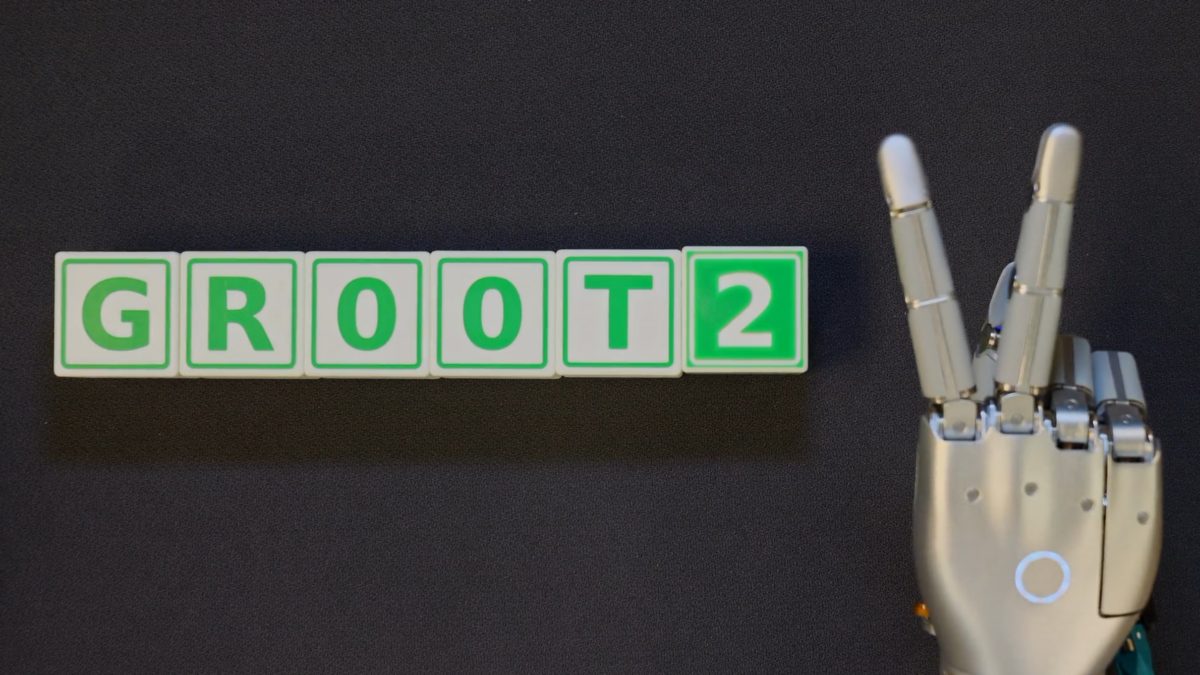
Can industrial enterprises eliminate manual teleoperation when teaching robotic arms to perform physical tasks? To train robots on new tasks, engineers usually spend hours remotely controlling the hardware, an operational bottleneck that remains slow, costly, and bound to specific machine configurations. As Nvidia announced, the company introduced an artificial intelligence foundation model named GR00T 2 designed to transfer human movements from video footage directly to robotic manipulators, removing the requirement for continuous manual guidance during dataset collection.
Nvidia eliminates the teleoperation barrier by shifting movement generation into a predictive visual architecture. Unlike earlier systems, including its predecessor GR00T 1, GR00T 2 avoids mapping raw camera inputs directly to motor controls. Instead, as Nvidia stated, the software functions as a world-action model that simultaneously calculates the subsequent motor movement and a short video showing the immediate future, anticipating visual changes such as an arm grasping an object.
Generative Video Over Manual Hours
To build this predictive pipeline, Nvidia trained the GR00T 2 system on a computing cluster equipped with more than a thousand GB300 chips. The dataset incorporated roughly 400,000 hours of video footage showing people executing various manual tasks while wearing head-mounted cameras. When combined with baseline motion profiles from a target robot, as the report outlines, the model generates an image of a robotic arm replacing the human limb and computes corresponding motor commands.
"Nvidia says the software works as what the company calls a world-action model. It simultaneously calculates the next movement and a short video of the immediate future."
In controlled testing, a robot equipped with five-fingered hands managed to light a match, slice a banana, and toss packages onto a conveyor belt without manual teleoperation sessions for those specific workflows. Across different standalone activities, unassisted success rates fluctuated between 10 and 80 percent, while a simulated nail-hammering routine was generated from a single video demonstration of human hand movement. While replacing manual teleoperation with video-based generation avoids hours of direct remote control, the available financial data lacks explicit cost metrics regarding hardware cluster investments, data collection expenses, or the exact dollar savings achieved by bypassing manual sessions.
Targeted Training and the Compute Bottleneck
Direct physical fine-tuning bridges the operational reliability gap. For 50 selected tasks where GR00T 2 performed well after a few demonstrations, less than three minutes of conventional training raised the operational success rate from 40 to 95 percent.
To execute complex multi-step routines, Nvidia pairs the architecture with a higher-level language model, such as OpenAI's GPT-6 Astra. The language model segments operations into sequential actions, designates grasping coordinates in camera feeds, and triggers error routines when parts fall. When researchers placed loose parts for toy models on a table in random order, the integrated setup assembled them in at least 97 percent of trials, compared to a 23 percent success rate across 100 attempts when the system operated without the corrective language model and fine-tuning.
For mobile units, Nvidia engineered a compressed variant called GR00T 2 Turbo that processes fewer image details. This variant executes directly on the Jetson Thor onboard computer of a humanoid robot, enabling tasks like clearing tables, scooping popcorn, and wiping floor spills with a foot-mounted towel, an action that succeeded in just under half of all runs.
This architecture exposes a clear infrastructure tradeoff between task precision and operational latency. During a trash-sorting test, the robot remained idle for roughly a third of the total execution time because it had to wait more than seven seconds on average for the planning model to deliver its next computation. Nvidia's research team also confirmed that the framework cannot yet process direct tactile sensor data and occasionally overlooks assembly flaws like half-turned screws, leaving physical touch feedback and planning latency as open constraints for autonomous deployment. Ultimately, while eliminating manual teleoperation reduces human intervention on the factory floor, the economic trade-offs still depend on balancing massive compute requirements against high latency and the necessity for supplementary fine-tuning.
Against the field
Can industrial plants actually cut operator costs by swapping teleoperation for predictive video? While the original architecture mapped raw camera feeds straight to motor commands, this new world model must continuously render short videos of the immediate future before driving any servo. The promised leap to operator-free robotics ultimately rests on a mobile setup that mops up spilled liquids successfully just under half the time.