AI · This text was generated with artificial intelligence
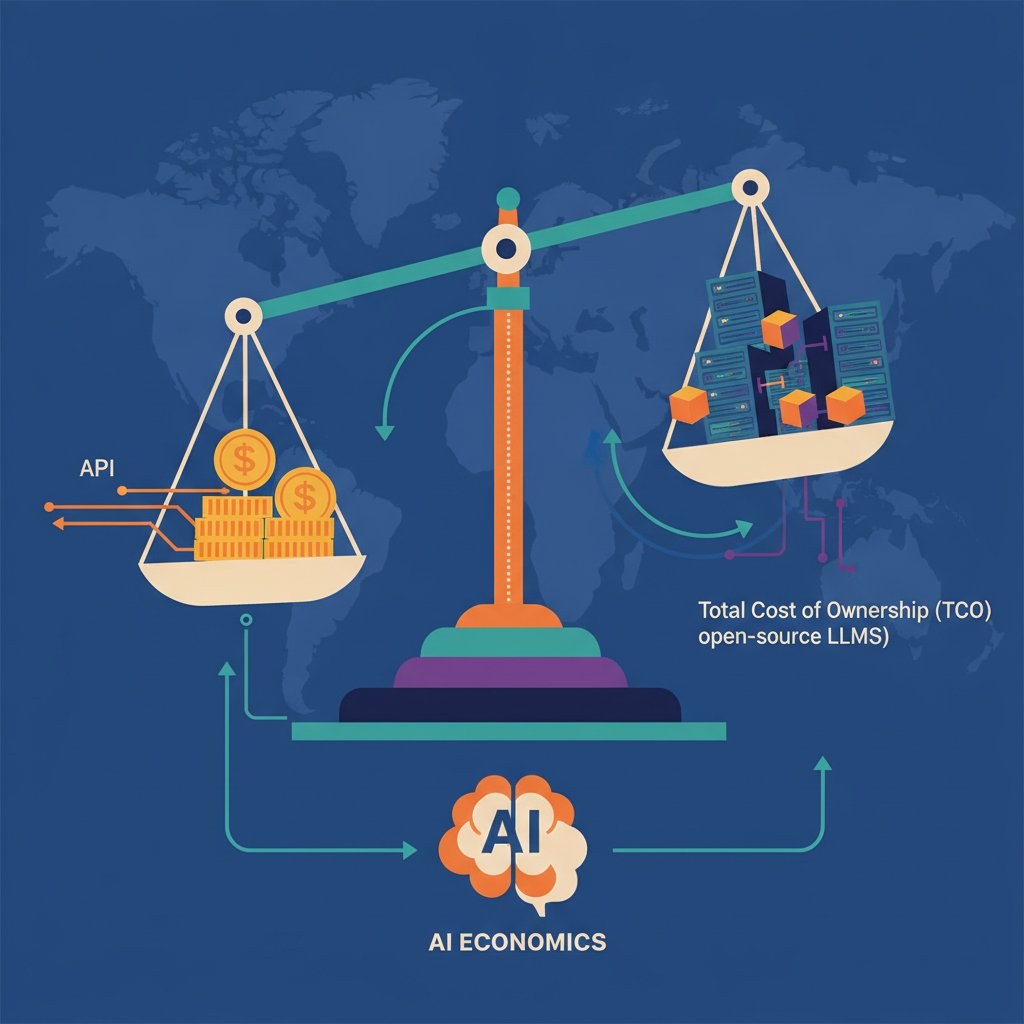
The debate over the financial benefits of migrating to self-hosted models has become a methodological trap. Businesses habitually compare the "price per token," forgetting that tokens are not the final product, but merely a raw material. Over the past year, open-source models like DeepSeek V4 Pro or Kimi K3 have closed the gap with proprietary leaders on benchmarks like SWE-bench Verified. However, comparable quality does not automatically translate into profit. The choice between APIs and in-house hardware has finally migrated from a technical question to an operational one, where capacity utilization is the only metric that matters.
The Brutal Reality of Hardware vs. Cloud
The economics here are unforgiving: APIs represent variable costs, while proprietary hardware is a capital expenditure with a permanent operational tail. Market estimates show that leasing an 8×H200 HGX node costs an average of $10,500–$14,600 per month on a long-term reservation. Purchasing the same setup requires an upfront payment of roughly $370,000, with monthly depreciation hitting $7,700—and that is before accounting for the payroll of the engineers required to maintain this high-tech menagerie. The break-even point only arrives at extreme utilization levels. If your servers sit idle two-thirds of the time, APIs will be cheaper, even if their nominal price seems prohibitive. The efficiency of self-hosting now depends entirely on how densely you can pack requests into every unit of time.
The Hidden Costs of Context and Logic
Another nuance is the "blended" price and actual context consumption. API providers charge 3 to 5 times more for output tokens than for input tokens; for instance, Claude 3.5 Opus costs $15 versus $75 per million tokens (input vs. output). Furthermore, different models consume different amounts of context for the same task. Attempting to compare them without accounting for the "harness" (the agentic wrapper) and the real-world solve rate is a deliberate oversimplification.
Recent testing indicates that changing only the agentic logic can result in a performance swing of up to 26 points, effectively erasing the gap between top-tier models.
Without fixing a token budget and accounting for all attempts required to solve a case, any cost comparison table remains nothing more than a vendor PR tool.
When the Math Finally Works
Competing with predatory pricing like DeepSeek’s ($0.229 per million input tokens) on your own hardware is virtually impossible. Doing so would require generation volumes that exceed the physical throughput of standard server configurations. Owning your stack is only justified when the data flow is so dense that API provider invoices start to resemble the GDP of a small nation.
Self-hosting requires nearly 100% hardware utilization to beat API pricing. Agentic overhead often influences the final bill more than the model's base cost. Open-source is a play for data sovereignty, not necessarily for immediate cost savings.
In the industry, switching to open-source is often framed as a path to independence and savings. For now, however, it more often looks like buying a mining dump truck for a grocery run: it certainly boosts your status, but it won't fit in the garage and it drains the fuel budget faster than you can hit the pedal.