AI · This text was generated with artificial intelligence
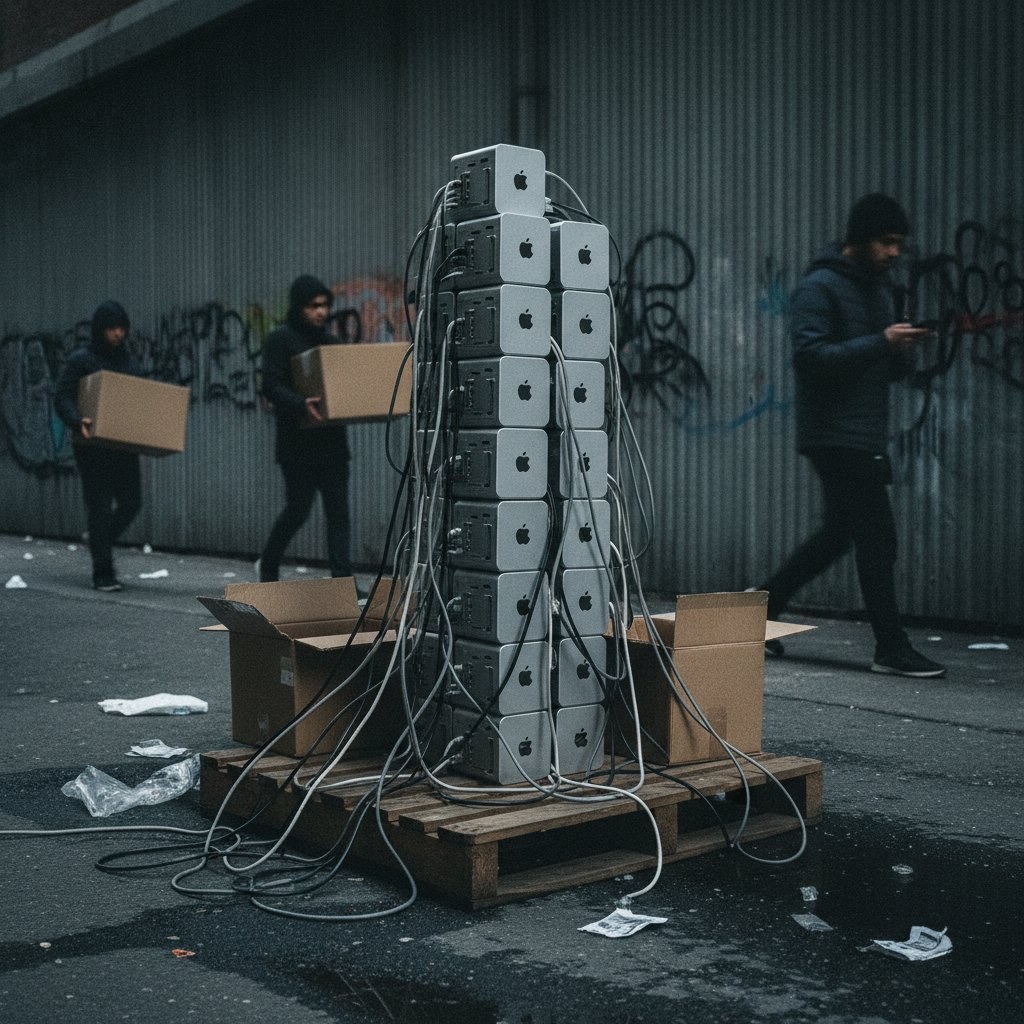
While the market continues to worship Nvidia H100 server racks, a quiet infrastructure shift is taking place in OpenAI and Anthropic laboratories. Both AI giants have started buying and renting tens of thousands of Mac mini and Mac Studio systems, including through AWS instances. The rationale is purely pragmatic: for reinforcement learning (RL) and testing autonomous agents, conventional GPU behemoths have proved too cumbersome and unjustifiably expensive.
The core of the problem lies in the mechanics of the RL feedback loop. Agents require continuous end-to-end inference and dense, low-latency interaction with their environments—browsers, terminal shells, or local codebases. Apple's Unified Memory Architecture (UMA) gives the CPU, GPU, and Neural Engine seamless shared access to a single pool of high-bandwidth RAM, bypassing the costly overhead of constantly shuffling data arrays across PCIe buses. In environment simulation workloads, a system-on-chip Mac configuration runs significantly more efficiently than a distributed server cluster built strictly for massive matrix multiplication.
This tactical pivot from brute-force LLM pre-training to agentic inference is already impacting Apple's enterprise supply chain, pushing delivery lead times for high-memory Mac mini and Mac Studio builds out by weeks and months. For enterprise leaders, the takeaway is clear: the era of blindly hoarding raw teraflops is giving way to latency-optimized, unified hardware setups, where a compact workstation can tackle complex agent workloads at a fraction of data center costs.