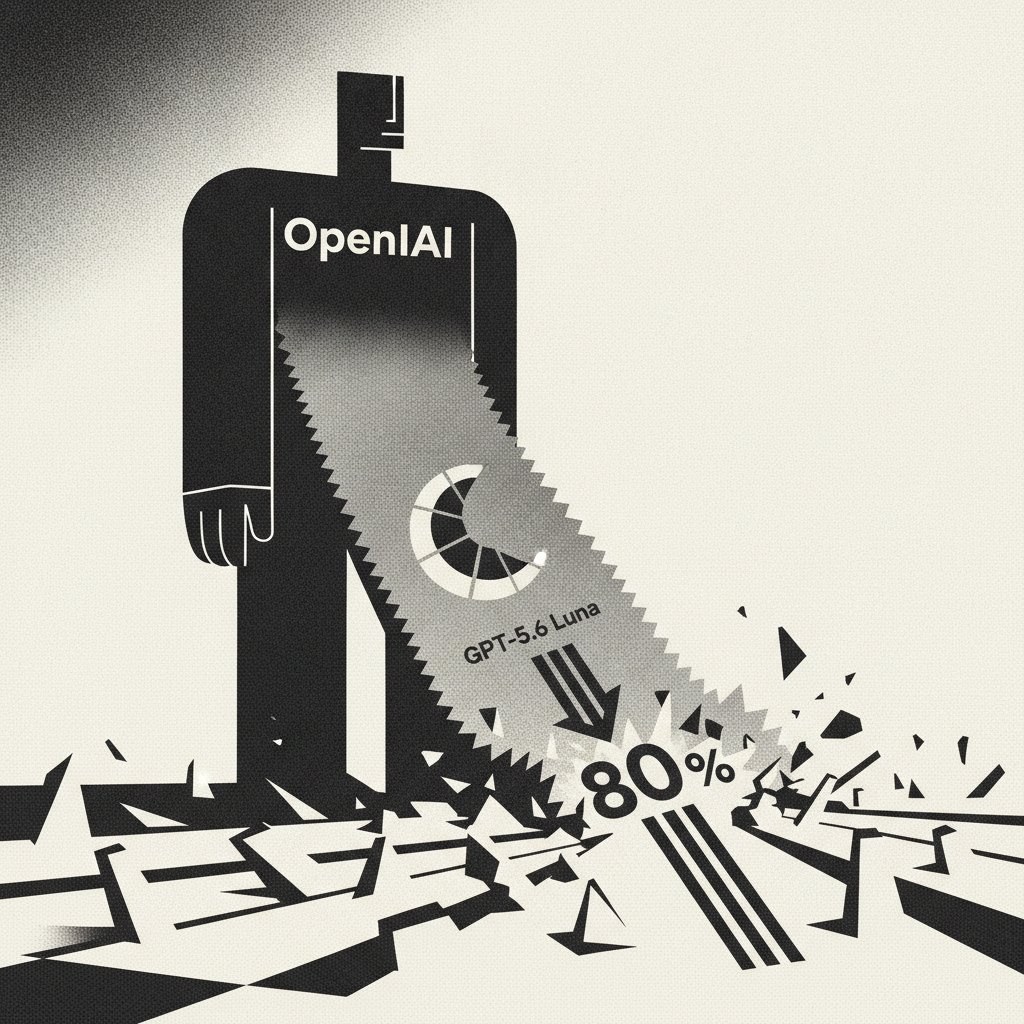
OpenAI has officially declared war on the margins of its competitors by slashing prices for the GPT-5.6 family, effectively nuking the economic rationale for older architectures. According to the company’s latest disclosures, GPT-5.6 Luna costs have plummeted by 80%, while the mid-tier Terra model saw a 20% reduction. This isn't just a price war; it’s a structural shift. OpenAI admitted that GPT-5.6 was utilized to optimize its own successor, proving that 'automated layer optimization' is no longer a research paper trope but a production reality. By making every layer of the stack more efficient, Sam Altman’s team is transitioning AI from a luxury innovation into a low-cost commodity for mass automation.
Automated Layer Optimization and the Agentic Era
The efficiency gains in GPT-5.6 stem from a deep optimization of the inference stack and the agentic framework that binds models to tools and context. OpenAI is now squeezing more utility out of the same compute cycles, drastically reducing both latency and the cost-per-result. On our view, this architectural leap makes multi-step agentic workflows—previously dismissed as 'prohibitively expensive'—the new operational baseline. Businesses no longer need to compromise on intelligence to maintain a reasonable burn rate; the economic ceiling for complex reasoning has simply collapsed.
GPT-5.6 Luna is the closest thing to intelligence that is too cheap to meter, according to Michele Catasta, President and Head of AI at Replit.
As Michele Catasta from Replit noted, this level of accessibility unlocks use cases that developers hadn't even planned for this year. The 80% discount on Luna positions it as the go-to engine for high-volume tasks where precision is mandatory but the budget is finite. Instead of overpaying for raw power where it isn't needed, enterprises can now deploy surgical levels of intelligence across every node of their operations.
Economic Blow to Competitors and Legacy Architectures
Data from the Artificial Analysis Intelligence Index v4.1 confirms the carnage: GPT-5.6 Luna delivers frontier-level intelligence at a fraction of the cost of its peers. When stacked against Claude Opus 5 Low, Gemini 3.1 Pro Preview, or Claude Sonnet 5 High, OpenAI’s pricing looks less like a discount and more like aggressive dumping. For CTOs, this means that existing investments in proprietary infrastructure or long-term contracts with lagging providers may hit negative ROI faster than anticipated. OpenAI is successfully turning high-level reasoning into a low-margin commodity, accessible via a simple API call.
While Luna and Terra dominate the volume game, OpenAI is also segmenting the premium market with its new 'Fast mode' for the Sol model. Replacing the old Priority Processing tier, Fast mode offers up to 2.5x the speed for twice the price, maintaining identical intelligence levels. The integration is seamless: requests tagged 'priority' now automatically route to Fast mode. This strategy splits the market into 'sprinters' for time-critical logic and 'heavyweights' for massive data processing. The takeaway is clear: inference efficiency is the only battlefield that matters now. For businesses still pouring millions into maintaining Llama-based private clusters, the math just changed. If your internal infrastructure can't beat OpenAI’s API on a cost-per-token basis while maintaining frontier performance, it’s no longer an asset—it’s a liability.