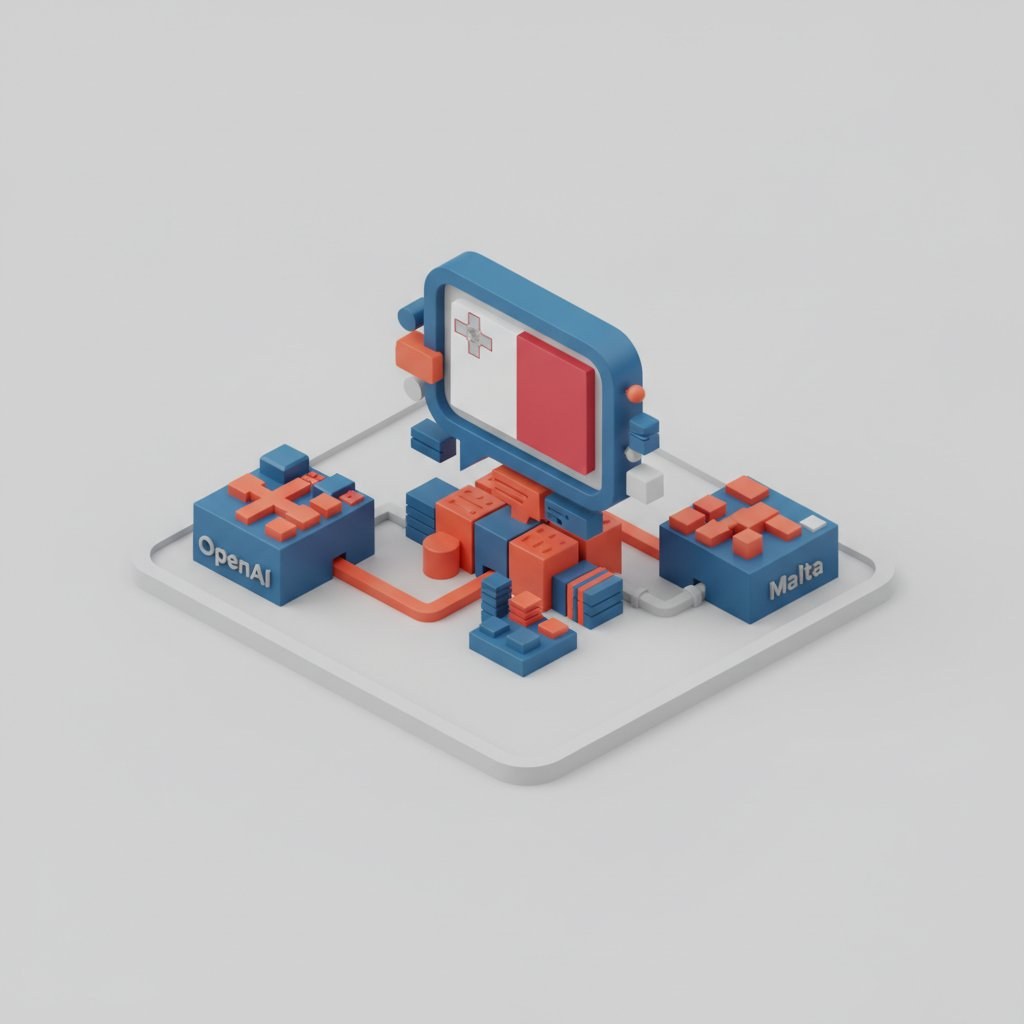
OpenAI and the government of Malta have launched the world's first experiment to transform neural networks into a basic public utility. According to an official statement dated May 16, 2026, every citizen will receive access to ChatGPT Plus. Sam Altman and his company are now positioning intelligence not as a subscription service, but as a global resource akin to electricity or water. To secure a year of free access, residents must complete an AI literacy course at the University of Malta—the state’s attempt to ensure that a high-cost tool doesn't end up in the hands of those who don't know how to use it.
Behind the noble facade of "digital enlightenment" lies the stark pragmatism of the OpenAI for Countries program. As George Osborne, who heads this initiative, explained, the partnership aims to create a national testing ground where model access and usage skills are woven into the social contract. Malta is becoming the ideal laboratory for refining agent deployment across an entire economy. OpenAI is making a qualitative leap: instead of an endless hunt for corporate clients, the company is taking an entire nation under its wing, making civil infrastructure and labor productivity critically dependent on proprietary code.
Malta’s Economy Minister Silvio Schembri claims the project will help families, students, and workers adapt to a new reality. However, the question of sovereignty remains unaddressed. In essence, the country is voluntarily embedding a foreign, closed-source model into its foundation, bypassing traditional software procurement cycles and creating a precedent of total vendor lock-in. Once daily life and government services are optimized for a specific intelligence, "switching it off" without collapsing the system becomes practically impossible.
Key Takeaways
Malta is the first country to implement ChatGPT Plus as a national public good for all citizens.
Access is contingent upon completing a mandatory AI education course from the state university.
The OpenAI for Countries program turns entire nations into testbeds for AI agents.
"The goal of the partnership is to create a national testing ground where access to models and the skills to use them are woven into the social contract" — George Osborne, OpenAI.
Risks and Outlook
The primary risk for this "beta-state" is obvious: how can strategic autonomy be maintained when a nation’s collective brain runs on the leased capacity of a private California firm? Malta is the first to test whether a national upgrade is worth the loss of control over its own cognitive processes.