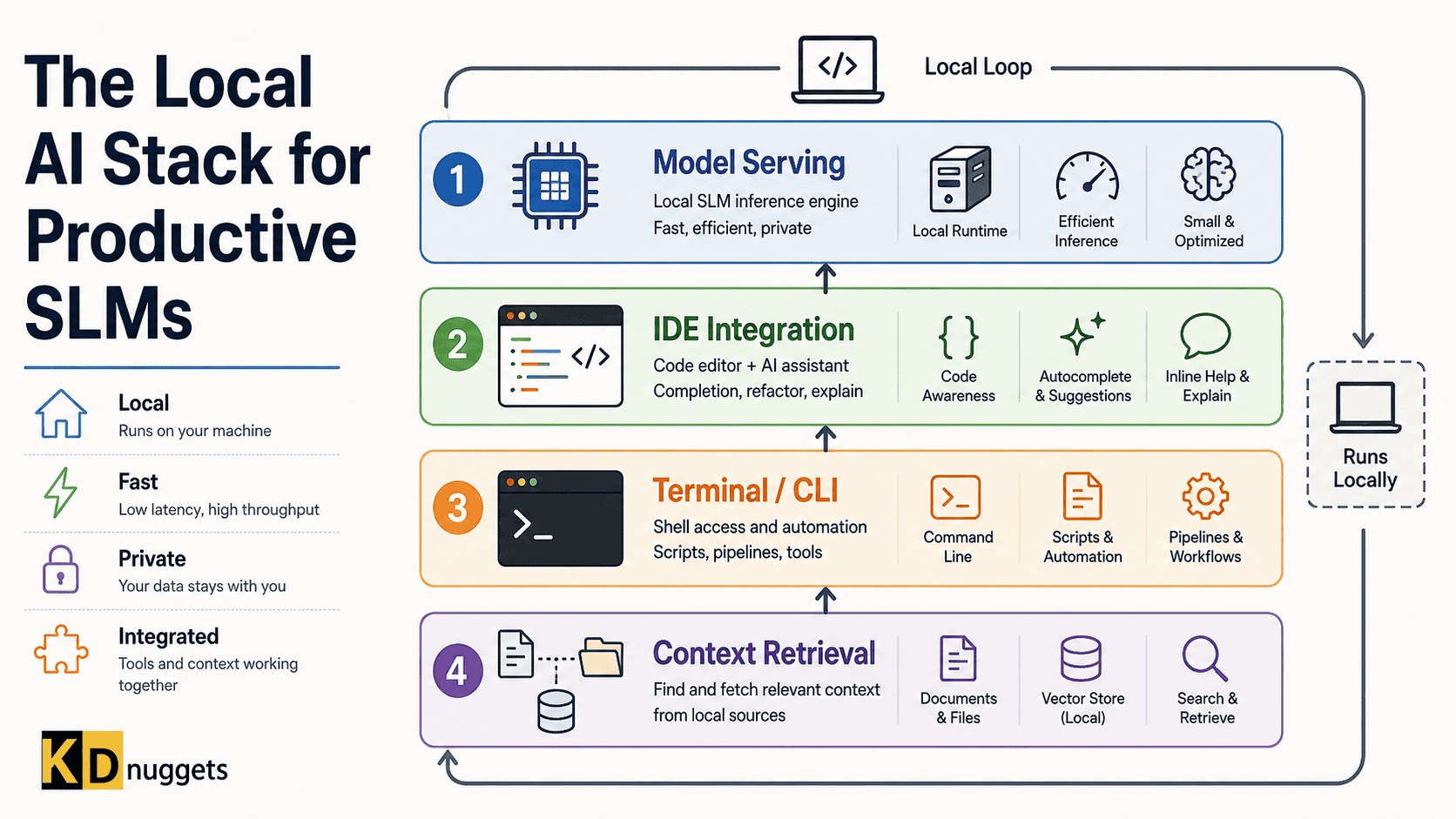
Running open-weight language models on on-premise hardware has shifted from an experimental hobby to a standard engineering decision. High cloud API expenses, data sovereignty mandates, and latency constraints are driving engineering teams toward compact Small Language Models (SLMs) in the 1B to 14B parameter range. These run comfortably on consumer-grade silicon with 8–24 GB of VRAM or Apple unified memory architectures. However, printing tokens in a terminal is a far cry from running a resilient corporate inference pipeline.
Choosing the Serving Layer
At the core of the local architecture sits the serving runtime, which manages low-level compute kernels, quantization, and API endpoints. Ollama remains the path of least resistance for single-developer workstations due to automated GPU discovery and zero setup, wrapping inference in an OpenAI-compatible REST endpoint. For rapid evaluation of unquantized Hugging Face weights, LM Studio offers an accessible desktop UI, though it carries unnecessary overhead for production background tasks.
Production deployments demand explicit trade-offs between hardware control and throughput. The foundational runtime llama.cpp provides granular control over compilation flags, 4-bit/8-bit GGUF quantization, and edge constraints. When scaling to multi-seat teams, vLLM becomes the logical target: its PagedAttention algorithm and continuous batching maximize GPU memory efficiency and manage concurrent throughput without collapsing context windows.
"The gap between 'I got a model responding in my terminal' and 'I have a local AI setup that actually improves how I work' comes down to tooling."
Understanding where compute limits hit serving orchestration keeps teams from over-engineering their hardware before establishing baseline latency metrics.
Bridging Models to Developer Environments
Connecting inference engines to actual IDE workflows requires robust context management, local retrieval-augmented generation (RAG), and reliable tool calling. Rather than settling for naive autocomplete, modern engineering environments wire local SLMs directly into autonomous coding harnesses.
Yet marketing claims regarding self-hosted autonomy require a reality check. Running complex agentic loops against 1B to 14B parameter weights consistently strains narrow context windows and exposes brittle multi-step reasoning. To replace cloud models successfully, technical leads must invest heavily in constrained prompting, structured JSON schema enforcement, and specialized fine-tuning rather than expecting raw local checkpoints to handle autonomous execution out of the box.