Tracing Multi-Source Evidence
Tool-using large language model agents increasingly interact with multiple endpoints simultaneously through the Model Context Protocol. Rather than relying on a single retrieved passage, an autonomous agent can query databases, read account records, call search tools, and pull metadata before compiling an answer. While this structure expands the scope of tasks an agent handles, it complicates factuality verification when claims from separate tools are blended together.
Traditional faithfulness benchmarks evaluate whether an agent's statement is supported by a combined pool of retrieved context. This approach overlooks cross-source conflation, where an agent states a fact that is true in one tool output but attributes it to another. On September 29, 2026, researchers Antonio Tiene, Ander Alvarez Sanz, Oliver Wirjadi, and Alessandro Genuardi from MultiverseComputingCAI released a paper titled ProvenanceGuard: Source-Aware Factuality Verification for MCP-Based LLM Agents to address this gap.
Architecture of the Verification Pipeline
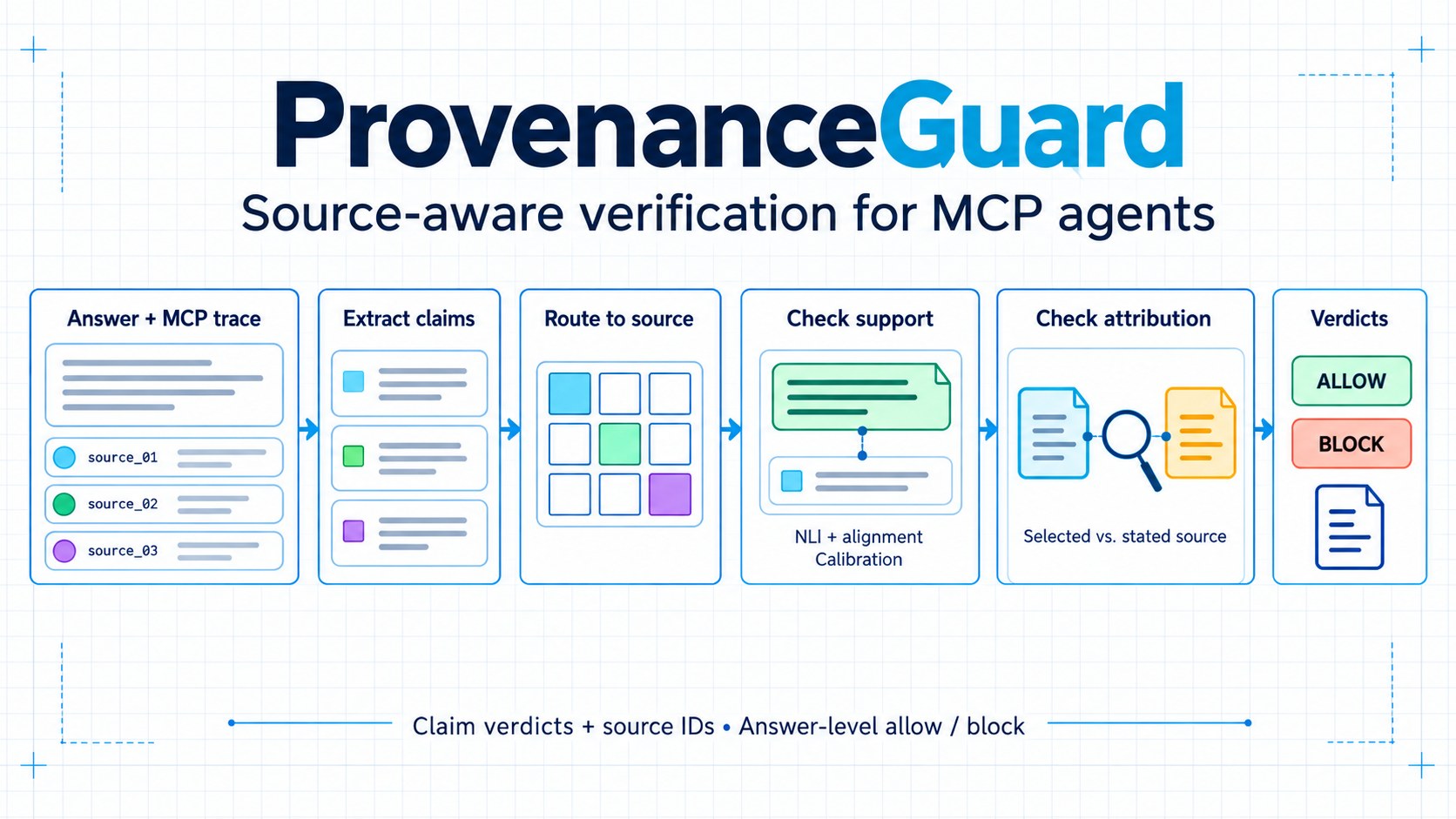
ProvenanceGuard operates as a post-generation verification layer positioned over a black-box MCP agent. The framework reads the captured Model Context Protocol execution trace, directly accessing tool outputs and their corresponding source identifiers without requiring any retraining of the underlying agent.
"ProvenanceGuard is a post-generation verification layer that sits on top of a black-box MCP agent."
In the experimental pipeline evaluated by the authors, local models processed the execution traces in a controlled, offline setup. A local language model decomposes generated answers into distinct claims, MiniLM identifies the relevant source for each claim, and a DeBERTa natural language inference verifier determines whether the assigned source actually supports the assertion.
Empirical Results and Trade-Offs
As autonomous agents migrate from single-document QA to multi-system orchestration via MCP, the economics of error shift from annoying hallucinations to enterprise liability. Without strict source-aware verification, companies face compounding operational failures and costly legal exposure every time an agent hallucinates a database cross-reference. The MultiverseComputingCAI framework proves that you do not need to retrain massive foundational models to enforce accountability; you just need to audit the execution trace before the output hits production.