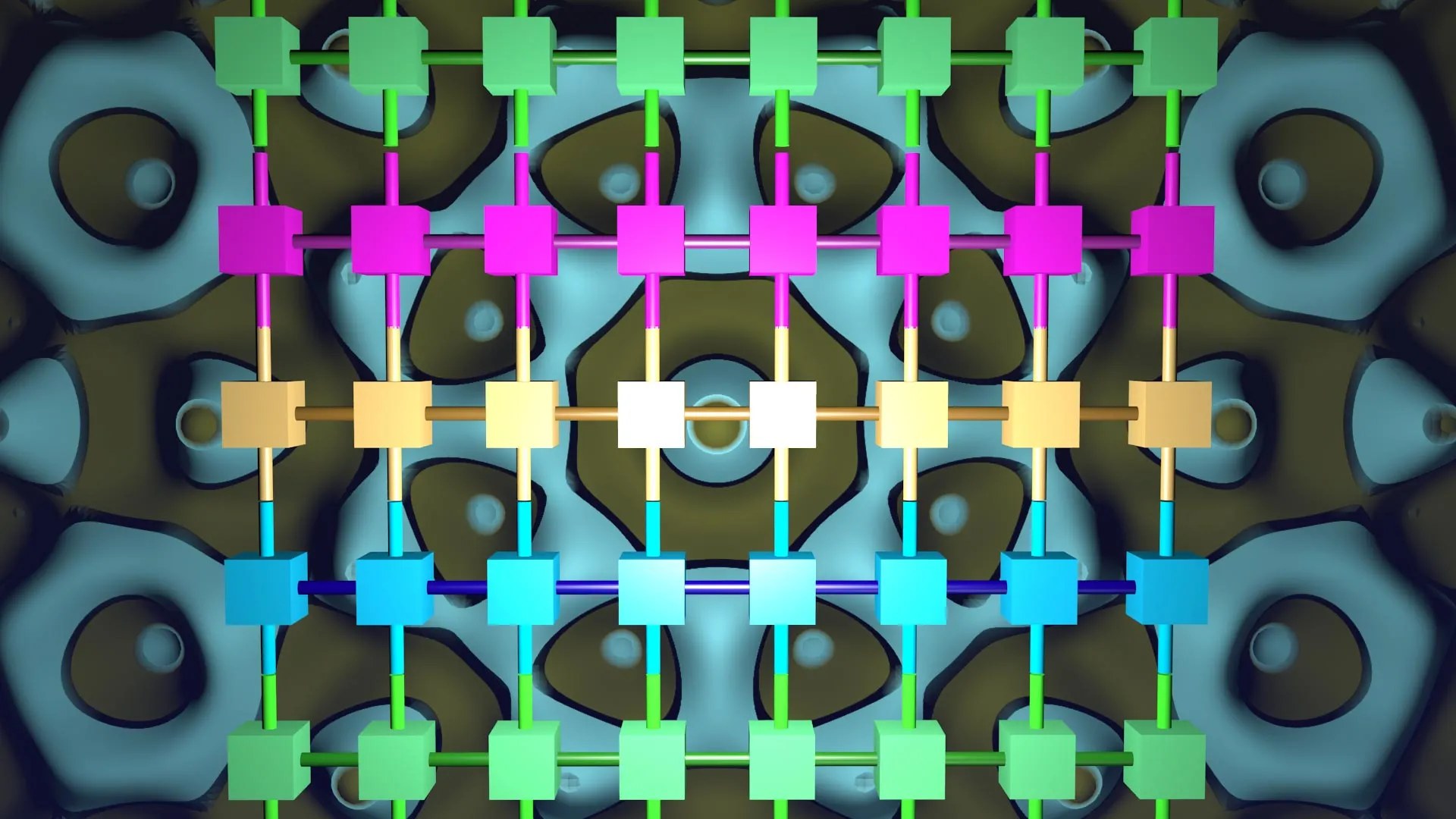
For years, modeling quantum materials has hit a computational ceiling. When researchers attempted to simulate quasicrystals—structures that possess order but lack the periodicity of standard crystals—mathematical complexity grew exponentially. Even the world’s most powerful supercomputers choked while processing quadrillions of variables. In essence, the search for new materials resembled a high-stakes gamble rather than deliberate engineering. A research group at Aalto University, led by Associate Professor Jose Lado, has solved this "impossible" problem by introducing a quantum-inspired algorithm that collapses calculations into linear time, delivering results in seconds.
Technical Breakthrough
The fundamental challenge with quasicrystals and super-moiré materials, such as twisted graphene, lies in their non-periodic nature. In solid-state physics, you cannot rely on traditional computational shortcuts. Lado and doctoral researcher Tiago Antão proposed a paradigm shift: instead of a brute-force approach, they implemented quantum-inspired encoding. This allows for the simulation of structures several orders of magnitude more complex than those currently considered the limit for classical hardware. The output provides engineers with a map of unconventional quantum excitations—the very elements responsible for protecting electrical conductivity from noise and interference, which is critical for building stable hardware.
Engineering Topological Qubits
For tech leads and hardware developers, the primary value of this method lies in the design of topological qubits. These are the foundation of future fault-tolerant quantum computers, where materials must maintain their properties under external environmental pressure. As Jose Lado notes, this creates a virtuous cycle: new algorithms allow for the design of better materials, which in turn are used to build more advanced quantum machines. The study, published in Physical Review Letters, explicitly identifies moiré structures as ideal hosts for such qubits.
The algorithm paves the way for dissipationless electronics, capable of radically reducing data center energy consumption. The method is adaptive and can be deployed directly on quantum processors as the technology matures. Insight delivery has shrunk from months to seconds, transforming complex calculations into a routine R&D step.
"The bottleneck has shifted from data centers to semiconductor cleanrooms," the researchers emphasize, noting that algorithmic precision now outpaces current physical synthesis capabilities.
Materials science is currently witnessing the collapse of the distance between hypothesis and validation. The primary obstacle is no longer a lack of supercomputing power, but the physical ability of laboratories to synthesize structures with the precision the algorithm now demands.