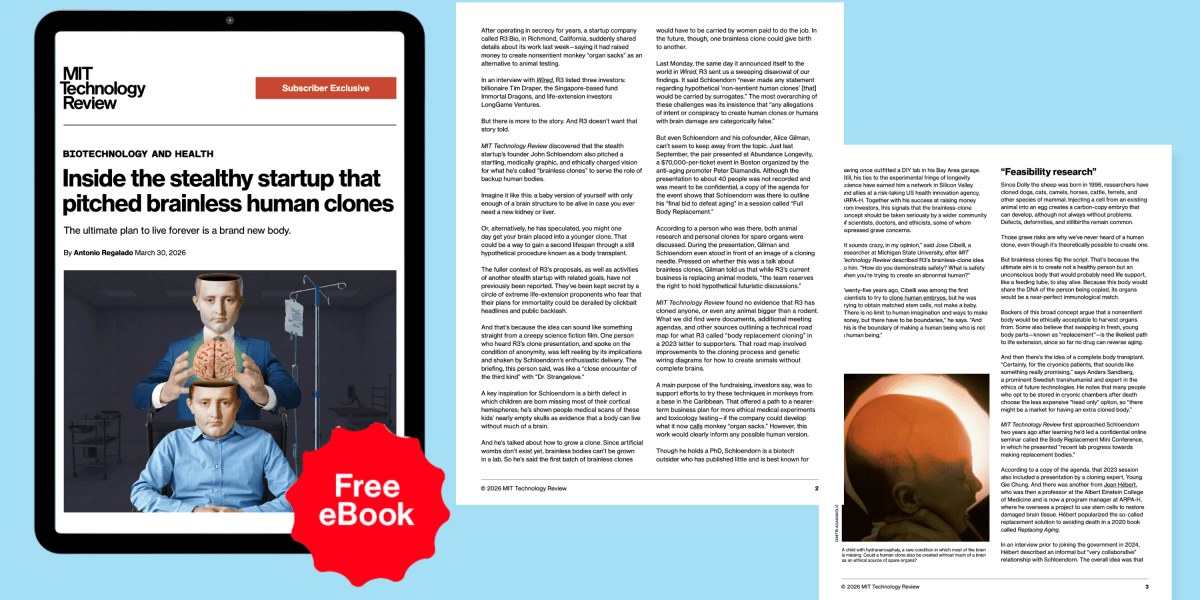
The quest for eternal life has taken a sharp turn into anatomical horror. R3 Bio, a stealth-mode startup, has unveiled a concept for 'spare' human bodies that redefines the boundaries of medical ethics. As reported by Antonio Regalado in MIT Technology Review, the project involves growing brainless human clones to serve as living warehouses of spare parts for their owners. Instead of complex anti-aging therapies, we are being offered a crude replacement of worn-out 'hardware,' where the human organism is demoted to the status of disposable biomaterial.
R3 Bio’s strategy is a calculated attempt to hack the legal system. By creating unconscious donors, the company seeks to bypass most ethical protocols: formally, a clone lacking higher brain function is not a person, meaning it can be harvested for organs without legal or sentimental friction. Experts view this not merely as regulatory arbitrage, but as technological extremism that transforms biological sovereignty into an exclusive commodity for the ultra-wealthy. While other investors bet on genome editing, R3 Bio is building a business on physiological outsourcing.
This approach threatens the reputation of the entire DeepTech sector. Against a backdrop of genuine progress in stem cell therapy, 'flesh-and-blood' startups like this risk discrediting the industry. This isn't medicine or even transhumanism; it is the creation of a legal gray zone where the lines between healing and biological barbarism are completely erased. In chasing survival for the few, the industry risks a level of public backlash that could bury legitimate life-extension research for decades.