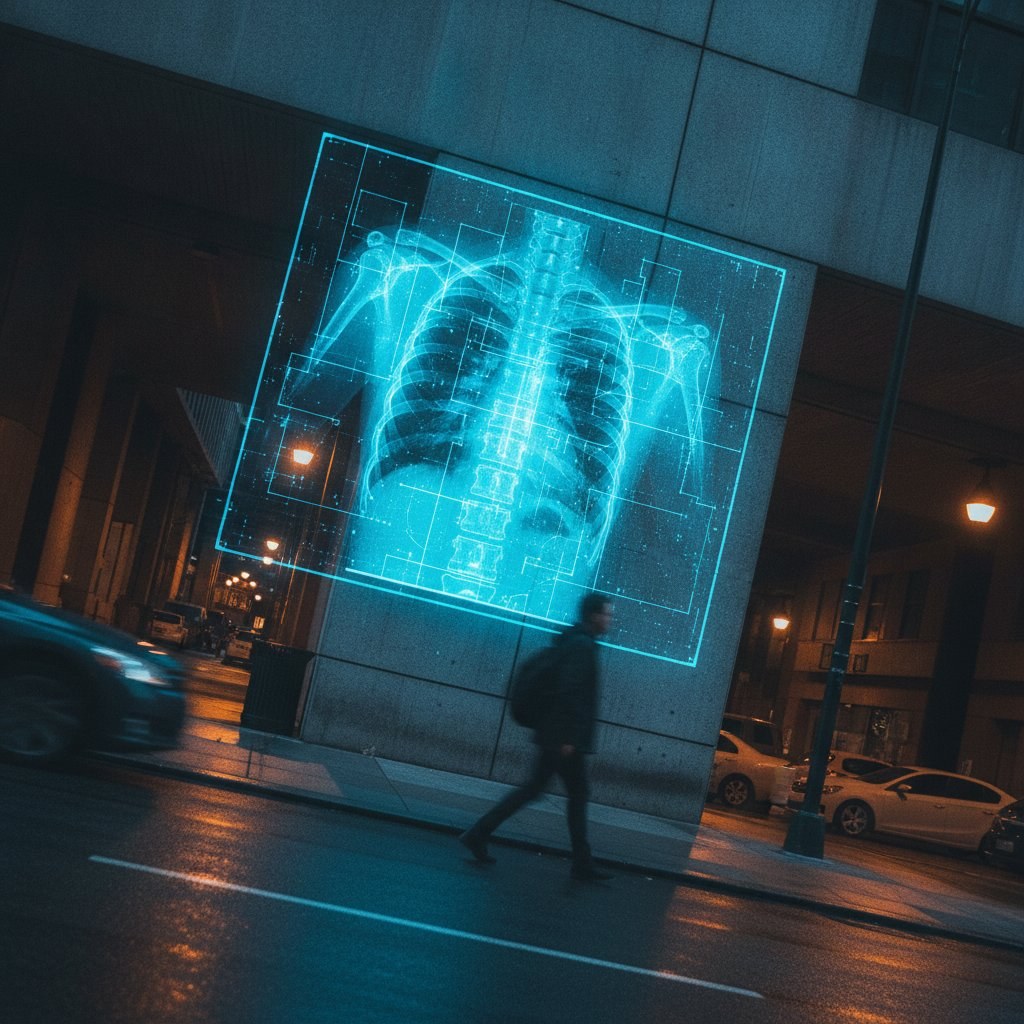
Modern AI models in radiology often resemble struggling students: instead of deeply understanding clinical nuances, they memorize statistical shortcuts. This lead to failures at the slightest change in imaging conditions or X-ray hardware. A research team from Imperial College London and the University of Edinburgh aims to end this with RadiT—the world's first generative foundation model for chest X-ray synthesis, trained from scratch with 1.3 billion parameters. By ditching common diffusion architectures for Rectified Flow Transformers, the developers have moved from mere image generation to precision medical synthesis.
Ditching Diffusion for Rectified Flow
The model’s technical core isn't just the 1.6 trillion tokens used for training, but a fundamental architectural shift. Unlike standard diffusion, Rectified Flow maps the shortest, "straight" paths between noise and data. This does more than save compute; it captures microscopic details that are typically blurred by traditional methods. RadiT ingested a heterogeneous dataset of 1.2 million images, allowing it to internalize the vast range of anatomical variations and imaging protocols that usually break smaller-scale solutions.
We have significantly raised the bar for realism in X-ray synthesis: the resulting images are virtually indistinguishable from real scans, even for experienced radiologists.
Scaling parameters to the billion-mark isn't about vanity metrics; it's the solution to the generalization problem. Where specialized models fail when faced with new equipment or specific patient demographics, RadiT uses its massive knowledge base to reconstruct chest anatomy across various pathologies and angles. This transforms the model from a content generator into a robust tool for modeling reality.
Clinical Validation and Controlled Synthesis
The primary value of RadiT lies in its capacity for controlled synthesis and editing of images for rare pathologies and underrepresented patient groups. In medicine, high-quality labeling is expensive, and data on rare diseases is perennially scarce, hindering the training of diagnostic systems. The model solves this by allowing researchers to "fill in" necessary cases for stress-testing algorithms. The realism of this synthetic data was confirmed in blind tests where experts could not distinguish generated pathologies from real ones—a level of fidelity previously out of reach.
High-precision X-ray synthesis is a direct path toward diversifying clinical data and stress-testing the resilience of diagnostic models.
However, a degree of skepticism is warranted: despite its technical sophistication, RadiT remains a generative model with inherent hallucination risks. The Imperial College researchers openly admit that synthetic data is a scaffold for training classifiers and correcting bias, not a replacement for real-world archives in clinical diagnosis. The project's goal is to create a "data architect" capable of building reliable models that don't degrade when moved from one clinic to another.