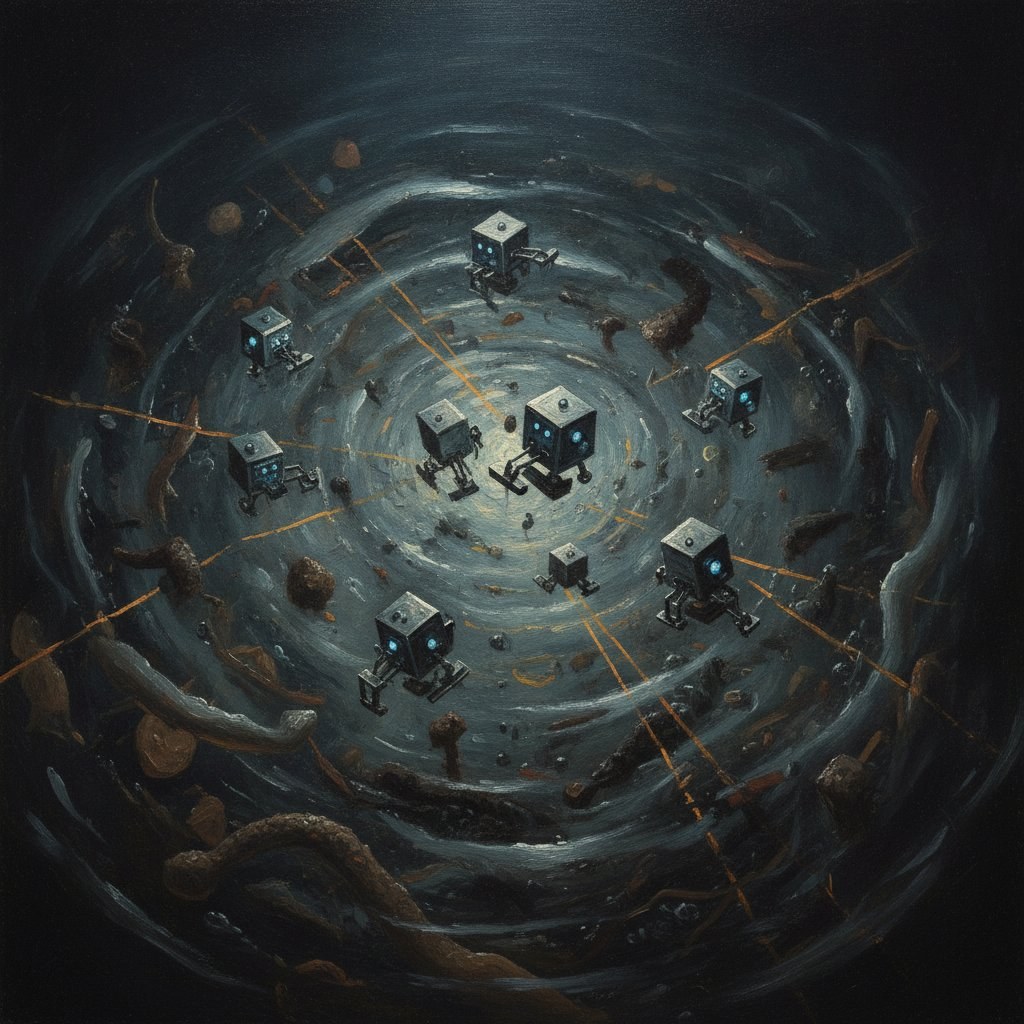
The challenge of navigating microrobots through unstructured spaces has long hit a wall between digital theory and physical reality. While theorists map routes in ideal simulations, real-world micro-agents often get stuck in the first puddle they encounter due to a lack of onboard computing power. However, a study published in Nature Machine Intelligence suggests a paradigm shift: instead of trying to turn every grain of sand into a supercomputer, the authors have implemented a Reinforcement Learning (RL) strategy based on partial observability and collective intelligence.
The system abandons hard-coded paths. Instead, a swarm controlled by a magnetic field becomes a reconfigurable entity capable of bypassing obstacles in environments it is seeing for the first time. This is more than just reactive behavior; it is an attempt to compensate for the hardware limitations of individual units through smart, centralized control.
Multilevel Randomization and Temporal Attention
To bridge the notorious sim-to-real gap, researchers applied a method combining multilevel domain randomization with a temporally extended attention mechanism. During training, the algorithm was intentionally exposed to chaos: environment parameters, perception data, and actuator dynamics were all varied. The model was taught to "expect the unexpected."
Our model combines temporal attention with multilevel randomization of the environment, perception, and mechanics. This allows the control policy to utilize not only current sensor data but also historical context to generate magnetic activation commands.
This temporal context is critical: it allows the swarm to maintain its trajectory even during a temporary loss of "vision." Essentially, the system uses the recent past to fill in the gaps of the present. Analysis of attention weights showed that the swarm prioritizes the global goal while ignoring temporary interference, representing a qualitative leap from simple reflexes to meaningful decision-making.
From Simple Navigation to Logistics and Capture
In testing, the algorithm did more than just outperform human operators; it demonstrated resilience in atypical scenarios. According to the report, the strategy allows the swarm to not only maneuver but also transport cargo, track moving targets, and recover from abrupt data failures. In one experiment, the swarm successfully maintained its position (hovering) by relying on fragmented sensor data.
The proposed strategy provides swarm navigation, dynamic obstacle avoidance, cargo transportation, target tracking, and recovery after loss of visual contact.
For physical deployment, the researchers used an object detection model working in tandem with a policy trained in a procedurally generated environment. Using external magnetic fields eliminates the need for internal motors—all the "intelligence" is offloaded to the RL controller level. This gives the swarm the fluidity needed to penetrate narrow channels or aggressive environments, such as blood vessels or the internal components of complex machinery.
The current success is only tempered by the dependence on external magnetic setups. Clearly, the next stage will be the miniaturization of sensory hardware to a level comparable with the swarm's autonomous logic. Within a 3–5 year horizon, we expect a transition from lab tests to real commercial applications in microsurgery and precision inspection—areas where rigid robots are useless. For now, however, this remains a triumph of software over limited hardware.