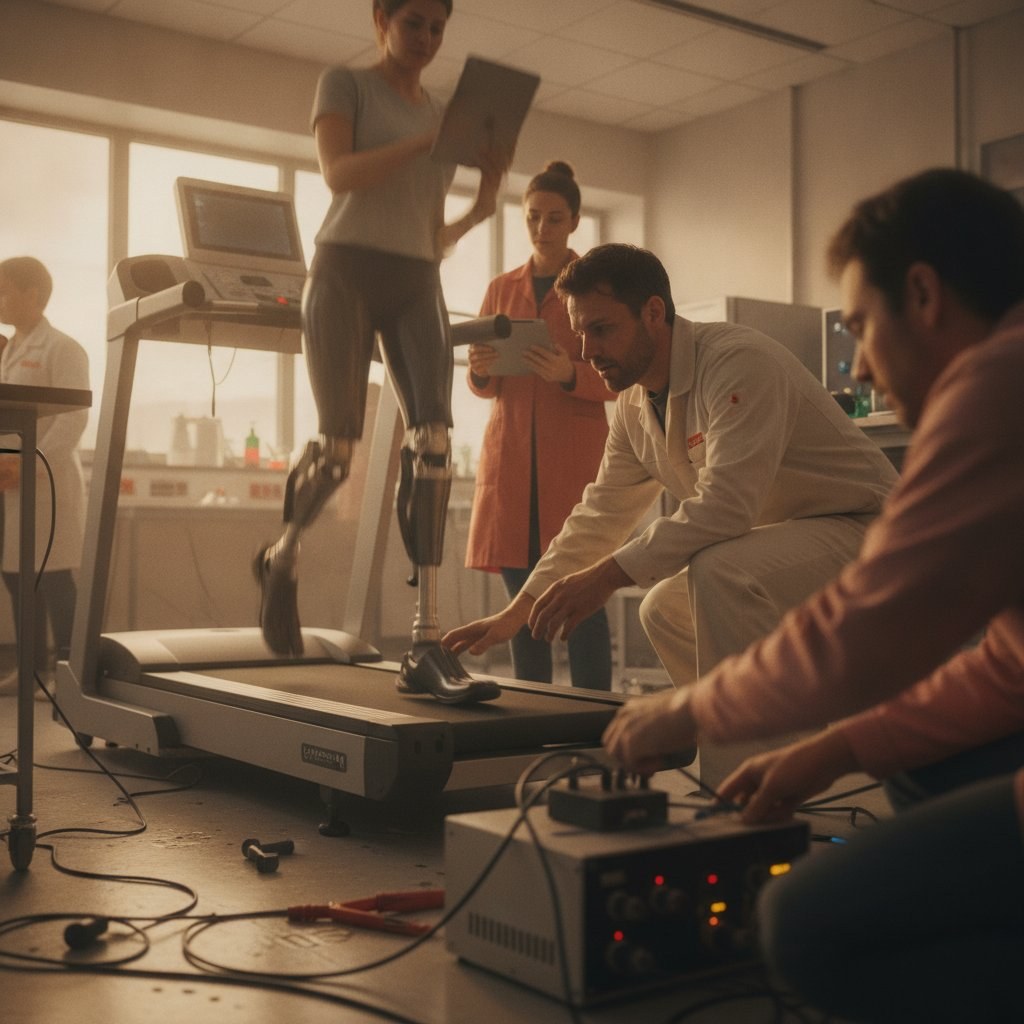
The bipedal robotics industry has entered a zone of strange paradox: iron athletes are shattering world records, yet they still struggle to cross a stage without a humiliating stumble. In April, the Honor Robotics D1 humanoid completed a half-marathon in Beijing in 50 minutes and 26 seconds. For context, Jacob Kiplimo’s human record is 57:20. The robot beat the world’s best runner by seven minutes, but this isn’t a triumph of technology—it’s a death sentence for the old school of engineering. We have rolled into an era where "teaching a robot to walk" has ceased to be an art form and has become a cheap commodity. It is now a million-ruble task requiring 20 minutes of GPU time, accessible to any startup with a GitHub account.
Developing a gait used to require decades of R&D. Consider Honda’s ASIMO, which was poked and prodded starting in 1986 based on Miomir Vukobratović’s Zero Moment Point (ZMP) concept. It was a mathematical dictatorship: as long as the center of mass projected within the foot's footprint, the robot stayed upright. The price of such stability was permanently bent knees, a tortoise-like pace, and a paralyzing fear of every crack in the pavement. Modern Reinforcement Learning (RL) has zeroed out these complexities, replacing the elegance of formulas with brute computational force.
The Democratization of Chaos
Today, the recipe for a "fast gait" can be prepared during a lunch break. The entire tech stack—from NVIDIA’s Isaac Lab simulators to open-source algorithms—allows a neural network control policy to run through millions of virtual iterations. This effectively destroys hardware as a competitive advantage. It doesn't matter how expensive your actuators are if an RL model can squeeze out a physical maximum that classical controllers simply cannot reach. Marc Raibert’s AI institute (RAI) proved this with Spot: a pure RL policy pushed the robodog to 5.2 m/s, far exceeding its factory limit of 1.6 m/s.
"The bottleneck turned out to be the battery—I thought we would hit the actuator limits first," admitted project lead Farbod Farshidian.
The accessibility of these tools has created a dangerous illusion. When Shanghai startup DroidUp boasts of a "92% human gait similarity" for its Moya robot, it sounds like a stroke of engineering genius. In reality, we see a crooked, unsteady walk that is light-years away from natural grace. RL excels at the task of "don't fall and get to Point B," but it fails at the complexity of biomechanics in non-sterile environments. The industry has learned to mimic the form of movement, but not its adaptive essence.
Marketing Instead of Stabilization
The gap between simulation and reality is pushing companies toward desperate measures. The XPeng IRON case became almost anecdotal: spectators were so skeptical of the robot’s autonomy as it hobbled across the stage that the CEO had to cut open its "leg" with scissors while the actuators were running. This was an attempt to prove there wasn't a dwarf operator inside. It’s a symptom of a systemic crisis: when stabilization algorithms fail to provide a breakthrough, the focus shifts to aggressive PR and hull-cutting stunts.
The problem is that we’ve hit an on-board computing ceiling. Training a model in the cloud is trivial, but making it work autonomously for hours—processing vision and memory in real time—is hindered by power consumption and the lack of continuous learning mechanisms. Even Boston Dynamics’ Atlas gave way to an electric successor not because of poor hydraulics, but because software based on MPC controllers stopped scaling.
The era of unique walking algorithms is officially over; it is now a baseline feature. Today’s primary risk for investors comes from companies selling "biomimetic" movement as a wrapper for raw, unrefined models. The future of hard tech lies not in outrunning marathoners, but in the ability to avoid becoming a pile of scrap metal the moment marketing promises collide with the physics of the real world.