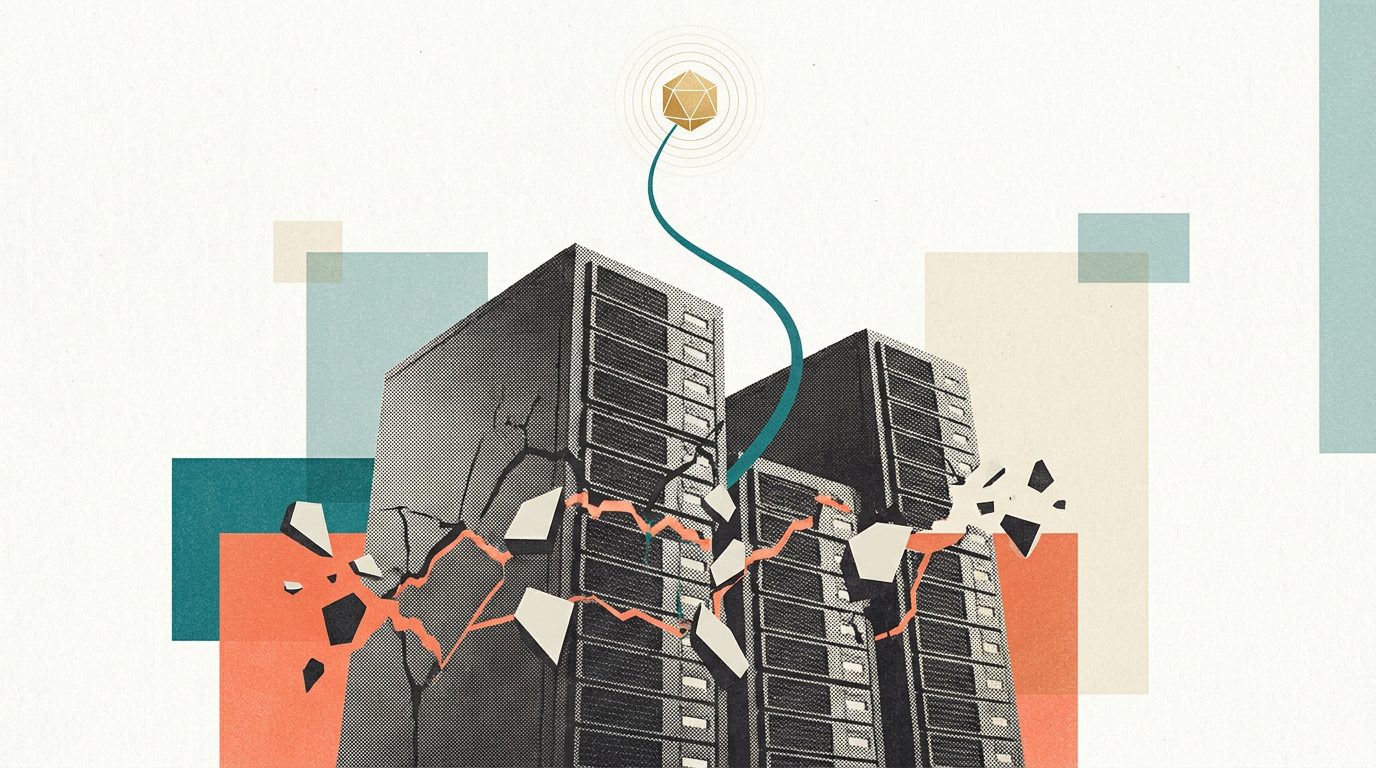
Turing Award winner Richard Sutton, author of the influential 2019 essay "The Bitter Lesson," writes in a new post that raw compute alone is no longer enough for intelligence. His assessment challenges the prevailing corporate playbook that equates massive hardware clusters directly with compounding business capability. The enterprise consensus had treated compute as a linear proxy for returns, yet the foundational architecture of contemporary models is colliding with structural limits.
Extensive scaling has reached an inflection point, forcing corporate capital to confront alternative learning architectures rather than simply financing larger server clusters. Billions of dollars in enterprise infrastructure spending remain tied to the premise that standard pretraining scales indefinitely. As Sutton stated, AI science needs clever new methods and is "far from finished." If the mechanical expansion of model size cannot deliver continuous capability gains, the capital expenditure models supporting existing enterprise roadmaps face systemic depreciation.
The Breakdown of Pure Scaling
In his famous 2019 essay "The Bitter Lesson," Richard Sutton argued that general methods scaling with compute beat sophisticated human-engineered approaches eventually. That framework became the ideological backbone for modern tech budgets. However, Sutton has pointed out that human expertise remains a bottleneck that prevents true scaling. When model builders turn to synthetic data to bypass the depletion of web text, they run into an ontological barrier. Sutton called synthetic data a "big mistake" because the real world is infinitely complex and any simulation of it is only "microscopic."
"The temporary success of transformer scaling, combined with a misreading of the bitter lesson, 'has reward-hacked the brains of a whole generation of scientists.'"
AI researcher Jerry Tworek, who left OpenAI to explore new AI approaches, observes that the bitter lesson still holds, but the more compute goes into model training, the more the algorithm matters. Tworek states that blind reliance on transformer scaling has distorted research priorities across the industry. AI researcher Jayden Teoh adds that he has repeatedly seen the bitter lesson hold back academic research, with promising avenues dismissed simply for straying from pure parameter scaling. Teoh wants the research community to stop dismissing such work as soon as it appears, noting that valuable contributions do not always have to survive scaling forever.
Can brute-force compute expenditures continue to substitute for architectural innovation?
They cannot, according to a cohort of researchers building outside the established labs. In Frontier Radar #5, researchers tracked 45 new AI labs betting on learning methods beyond pretraining and reinforcement learning. Tworek runs Core Automation, searching for learning algorithms that operate outside that traditional pair. Richard Sutton runs Oak Lab, which brings together founders who believe in much more capable AI but doubt today's recipe alone will achieve it. On 2026-07-13, Oak Lab set its technical North Star as a trillion-parameter agent capable of real-time learning and task planning while consuming a mere 20 watts (we covered this on 13.07).
The Incumbent Defense
Against this shift, the leaders of the most capitalized foundation model companies defend the traditional trajectory. OpenAI CEO Sam Altman considers large language model scaling far from exhausted and accuses LLM critics of slowing down an entire generation of researchers. As evidence, Sam Altman points to an OpenAI model that recently disproved a mathematical conjecture mathematicians had long failed to crack. Dario Amodei, CEO of Anthropic, takes an identical commercial stance, calling scaling progress a rainbow with no end.
Both executives oversee businesses whose corporate valuations and infrastructure commitments rest on that premise. While their models solve isolated formal puzzles on massive compute clusters, their critics pursue agents designed to continuously adapt on a 20-watt budget (we covered this on 13.07). The market is asked to treat an endless rainbow as a balance-sheet asset.
Against the field
Billions of dollars keep pouring into compute clusters, yet the very architect of the brute-force doctrine now declares standard scaling insufficient for genuine intelligence. For years, tech giants treated the 2019 thesis as a blank check for hardware, sidelining promising research that strayed from adding raw parameters. That mechanical approach hit a wall once natural text ran out, proving that synthetic simulations cannot capture the complexity of the physical world. The philosopher who convinced the industry that raw compute solves everything now warns that his disciples spent their capital on the wrong problem.
Our stories: Oak Lab: Richard Sutton’s RL vs GenAI (July 13).