AI · This text was generated with artificial intelligence
In maritime security, the cost of an error isn't a glitchy pixel; it's tons of wasted fuel and the lives of crews dispatched on wild goose chases. According to Kyle Wiggers of Ai2, for an analyst, an AI hallucination means sending a patrol vessel hundreds of miles into a void. The flaw in legacy systems lies in their inability to handle real-time dynamics: satellite signals and coordinates shift by the second while a model struggles to "recall" data from its static weights. In developing Shippy, the Skylight team bypassed traditional RAG in favor of a system that verifies every move through a live data stream.
The Anatomy of Trust Through Modular Architecture
Shippy’s architecture pulls back the hood of the typical "black box," deconstructing the system into three distinct components: the "soul," skills, and configuration. The "soul" isn't a metaphor—it’s a rigorous system prompt establishing behavioral guardrails. Under the hood, Shippy relies on Claude 3.5 Sonnet (or Opus) and the OpenClaw framework, packaged in Docker to ensure version predictability. This type of "brain containerization" is arguably the only way to prevent system degradation when the next API update rolls out.
"Building an AI agent for critical domains like ocean conservation is primarily a reliability challenge, not just a text generation task."
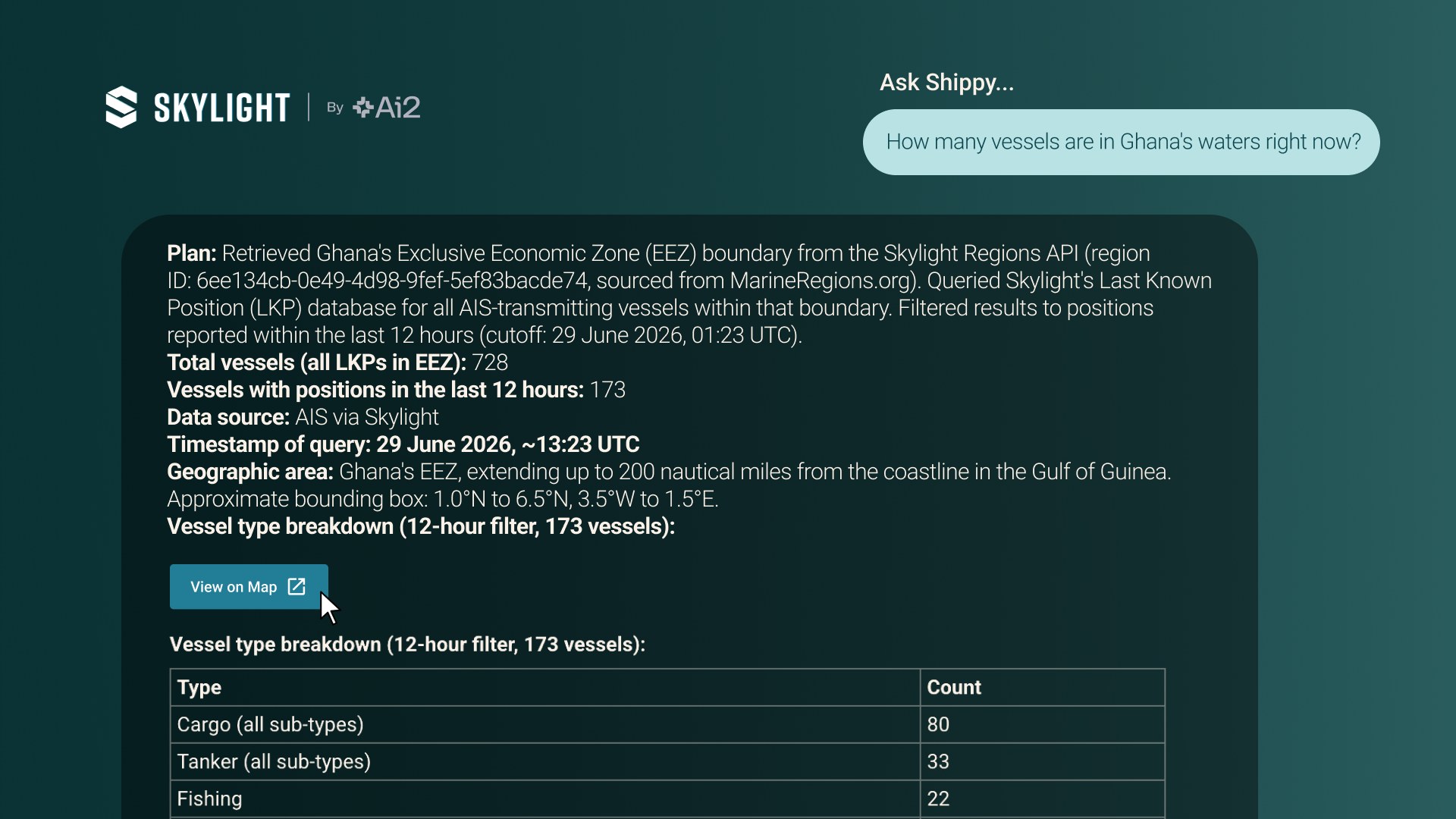
Agent skills are defined in Markdown, allowing Shippy to interface directly with the Skylight API. This enables the instant capture of Events—from suspicious ship-to-ship transfers on the high seas to illegal crossings of Exclusive Economic Zones (EEZs). Instead of guessing where Ghana’s territorial waters end, the agent makes a direct call to a geographic registry.
Verification Interfaces and the Economics of Reliability
A critical element of Shippy is its source tracing visualization. When a user requests a fisheries report, the agent doesn't just output a paragraph of text; it unfolds a "reasoning log" showing how it converted a zone name into a coordinate polygon, queried the API, and provided a deep link to a map. This fundamentally shifts the analyst's role from a passive reader to a supervisor. By seeing the source of every boundary and the timestamp of every signal, users can verify data instantly without leaving the workflow.
Scaling Ai2’s experience proves that deploying AI in the public sector and security is only viable through narrow specialization and a "short leash" on verifiable databases. Shippy combines Skylight’s proprietary data with open registries, uncovering schemes to bypass Marine Protected Areas (MPAs) in a single conversational turn. In a world where output transparency is valued over model creativity, this approach is becoming the gold standard for managing complex infrastructure. While system efficiency still hinges on the discipline of AIS signal transmission by vessels, Shippy represents a compelling move to turn an unreliable LLM engine into a precision monitoring tool.