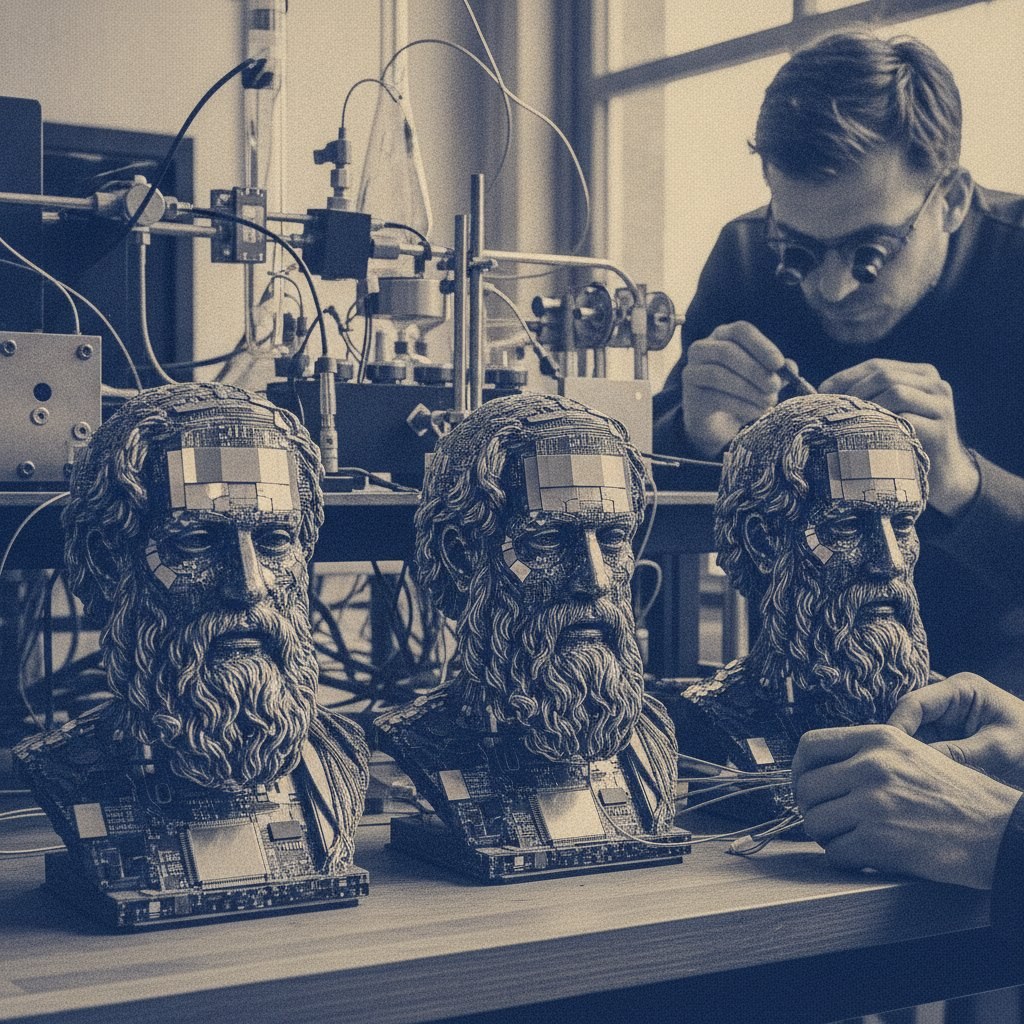
Modern scientific automation has hit a procedural dead end. While classic AI dutifully adjusts knobs and optimizes parameters within set boundaries, it remains little more than an advanced script lacking epistemic autonomy. To achieve a real breakthrough, machines must learn not just to grind through data, but to construct and—more importantly—challenge physical explanations. Research by Xianrui Zeng and colleagues from the Hangzhou Institute for Advanced Study and the Chinese Academy of Science introduces AHOIS: a system of "scientist agents" that embeds Socratic reasoning into a closed-loop experimental cycle. This framework attacks the "curse of dimensionality" in complex physical systems through internal dialogue and critical interrogation.
The Architecture of Socratic Interrogation
At the heart of AHOIS lies a specialized Critic agent, acting as a computational "midwife" for scientific truths. Unlike linear algorithms that blindly maximize a reward function, this critic grills hypotheses with structural causal questions and physical constraint checks. The process forces the AI to move from fragile, implicit reasoning to the creation of explicit, testable models. By generating counter-examples and formulating falsification criteria, the system mimics a human researcher’s ability to identify their own zones of ignorance. This shift from simple parameter optimization to model formation is critical in high-dimensional spaces, where brute-force methods fail due to the sheer vastness of the search area.
A measurement only gains scientific meaning when it confirms or refutes an explanation of the system; a hypothesis is only useful if its assumptions are transparent.
The study proves that the Socratic approach is not philosophical window dressing, but a functional necessity for ensuring reliability. Benchmark tests showed that internal interrogation radically improves physical consistency and uncertainty calibration. The multi-agent architecture distributes roles: literature review, planning, and analysis are separated, allowing the system to maintain a living, evolving model of reality that updates as experimental evidence accumulates.
Validating Autonomy: From Optics to R&D
The effectiveness of AHOIS was tested on a multi-mode fiber platform—an environment characterized by high-dimensional wave transformations and constant parameter drift. Without prior speckle models or encoding schemes, the system independently proposed and confirmed a random interference hypothesis. The agents discovered adaptive measurement strategies and successfully diagnosed technical failures, including fluorescence contamination and detector noise. Ultimately, the resulting encoding achieved classification accuracies of 76.97% on MNIST and 83.17% on Fashion-MNIST with an effective rank of 56.9. This isn't just a "lucky run"; it is proof of AI's ability to translate theoretical knowledge from papers into an executable workflow on unfamiliar hardware without human prompts.
Business Takeaways
For tech leads and researchers, the Socratic method shifts the focus from chasing "fast data" to finding the "right questions." The system’s ability to operate in high-dimensional spaces without a priori data promises a drastic reduction in R&D cycles for materials science and complex optics. We are witnessing a long-awaited departure from "black boxes" toward self-correcting systems capable of articulating their failures. The main takeaway for those building automated research pipelines: stop endlessly tweaking parameters and start building systems that know how to argue with themselves.