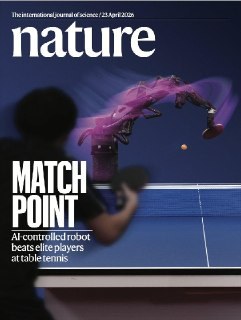
While the industry has spent years scraping away fractions of a second from production cycles, Sony AI has shifted the conversation into the realm of extreme physics. In a report published in the journal Nature, the company unveiled 'Ace'—a system that recently delivered a masterclass to professional players under the observation of Japan Table Tennis Association officials. This isn't just a PR stunt for the sports pages; it is a brutal benchmark. Sony has cracked the fundamental problem of latency, achieving a response time of just 20.2 milliseconds. To put that in perspective, it is 11 times faster than the reaction time of an elite athlete, which sits around 230 milliseconds. The era of robots confined to slow, predictable scenarios has officially ended.
The mechanics of this dominance are built on hardware aggression and algorithmic distillation. Ace utilizes 200Hz cameras, capturing even the logo on a ball flying at 150 km/h to instantly determine spin type. Its eight-jointed structure is managed by a system trained via the 'privileged critic' method. According to Sony AI developers, this principle—previously refined in the Gran Turismo racing simulator—allows the robot to learn from an 'ideal teacher' in a digital environment and transfer those skills to the real world. Consequently, Ace does not merely mimic humans; it creates its own physical movement logic. Former Olympian Kinjiro Nakamura noted that the robot delivers shots previously considered impossible for human biomechanics. Furthermore, the system requires no prior scouting of its opponents—it adapts to playing styles on the fly.
In strategic terms, this represents a transition from rigid, hard-coded algorithms to autonomous systems with true 'reflexes.' Where automation previously failed in unstructured environments, the Ace tech stack thrives where decisions must be made in milliseconds based on visual streams. This is a direct signal to the logistics and critical infrastructure sectors: the physical barrier separating machine precision from human dexterity has been demolished. We are witnessing the first instance of an AI system reaching expert-level proficiency in a dynamic physical sport, setting a new standard for any industry requiring instantaneous reactions to chaotic inputs.
For business leaders, the Ace case study isn't about table tennis—it's about the radical expansion of automation zones. Systems with 20-millisecond latency allow for the deployment of robots into high-speed processes where human intervention was once indispensable. It is time to stop viewing robotics as a collection of slow-moving machinery. We are now looking at a legitimate replacement for expert personnel in high-velocity physical tasks, where the margin for error is measured in millimeters and microseconds.