The Working Memory Architecture
When artificial intelligence solves complex mathematical proofs, commentators reflexively invoke emergent conceptual intuition or opaque algorithmic leaps. As researcher Davide Piffer points out, the reality is far more mechanistic: frontier models simply operate with a symbolic working memory orders of magnitude larger than human biology permits. Rather than functioning as an electronic Einstein conjuring qualitative shifts in perspective, modern AI acts as a machine-amplified von Neumann—brute-forcing operations with vast combinatorial speed, breadth, and zero intermediate state degradation.
Human cognitive architecture hits a wall when tracking deep formal logic. Even a world-class mathematician can actively juggle only a handful of unfamiliar symbolic variables before offloading state to scratch paper and formal shorthand.
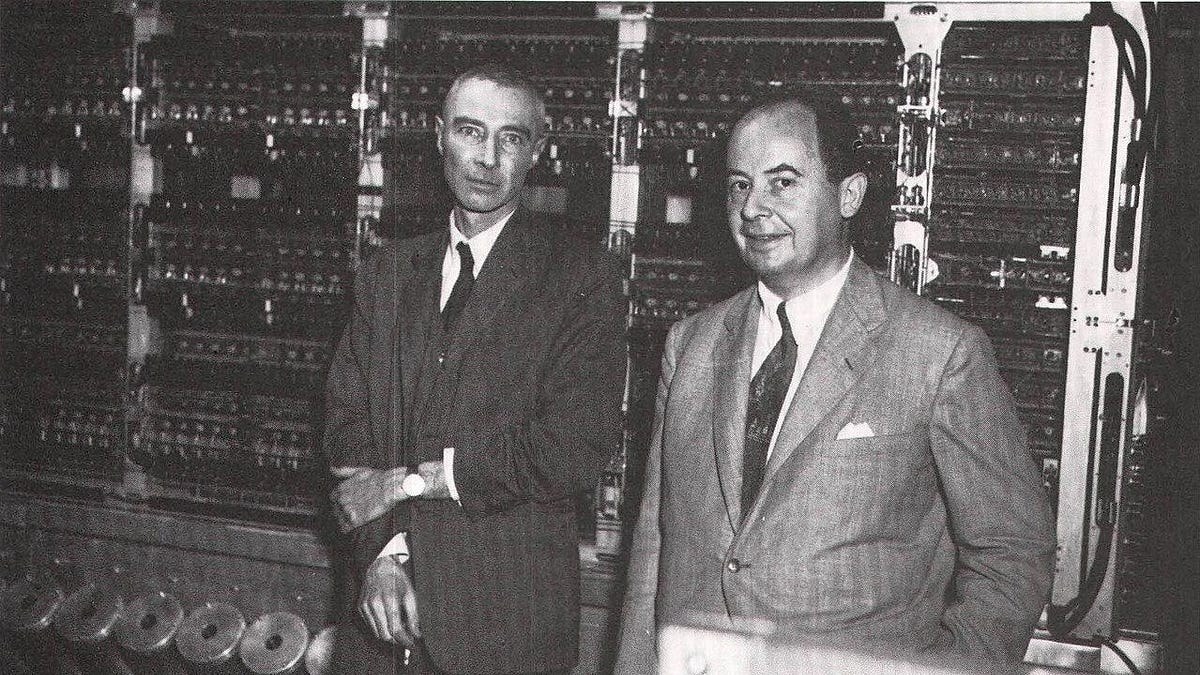
AI may be less like an electronic Einstein than a machine-amplified von Neumann: immense speed, breadth and symbolic memory.
An AI model bypasses these biological choke points entirely, holding the complete problem space, hundreds of intermediate derivations, abandoned paths, formal constraints, and active lemmas inside its context window simultaneously.
Cognitive Limits Versus Context Windows
In human cognition, working memory is the bottleneck where complex calculations break down—not because the logic is opaque, but because partial values decay while subsequent operations run. Experts work around this via chunking, compressing familiar structures into single conceptual handles to squeeze data through fixed biological bandwidth. But compression is a patch, not an expansion. AI systems require no such cognitive compression; they maintain the entire uncompressed operational state without frictional decay.
Reframing High-Complexity Workflows
Demystifying model reasoning as scaled symbolic working memory demands an immediate strategic recalibration for engineering teams. Pursuing elusive "creative AI intuition" in enterprise R&D is a capital trap. Real operational leverage lies where human working memory degrades under combinatorial load: multi-step constraint evaluation, deep dependency tracing, and relentless state tracking across millions of tokens.
Engineering roadmaps should orient around high-leverage formal domains—pairing large context models with formal verification engines (like Lean or Coq), continuous codebase auditing pipelines, and structured proof synthesis. Success in enterprise AI deployment will not come from simulating synthetic genius, but from systematically automating the dense logical state tracking that breaks biological brains.