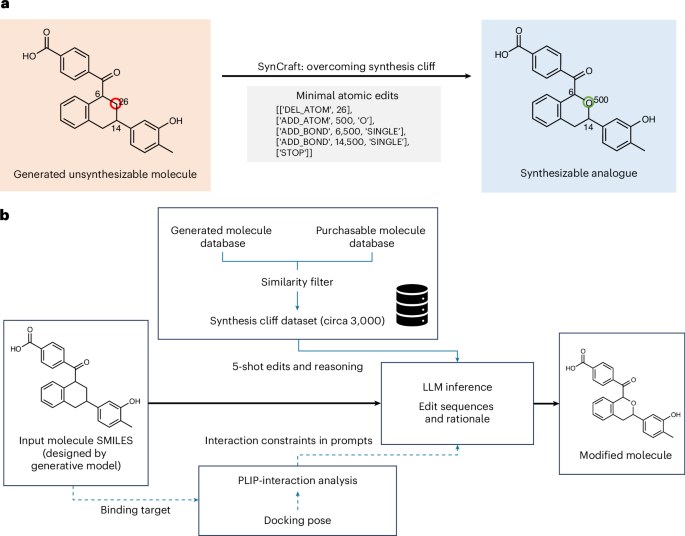
Generative artificial intelligence has spent years churning out endless lists of molecular blueprints that look brilliant on a GPU and turn out to be completely useless at the bench. According to the September 2026 study in Nature Machine Intelligence, the new SynCraft framework finally addresses this expensive disconnect by refusing to let large language models invent impossible molecules.
Traditional fixes, such as post-hoc filters or rigid projection methods, usually ruin structural novelty or mangle key pharmacophores just to fit some pre-approved laboratory template. As detailed in the Nature Machine Intelligence paper, SynCraft reframes optimization not as naive sequence translation, but as a precise structural editing problem.
Precision structural editing
Instead of letting models hallucinate raw SMILES strings that collapse the moment a chemist looks at them, SynCraft directs language models to predict executable sequences of atom-level edits.
"By predicting executable sequences of atom-level edits rather than generating SMILES strings directly, SynCraft circumvents the syntactic fragility of LLMs while harnessing their chemical intuition."
This approach lets the system navigate the stubborn 'synthesis cliff' where minor structural tweaks make the difference between a viable compound and a chemical dead end.
Benchmark gains and prospective rescue
Extensive benchmarks in the study demonstrate that SynCraft routinely beats existing baselines at generating synthesizable analogues without sacrificing structural fidelity. Crucially, this performance holds up across both proprietary and open-weight backends, proving the results stem from the method rather than any single vendor's secret sauce.
Through interaction-aware prompting, the framework successfully mimics expert medicinal chemistry intuition. It even rescues high-scoring RIPK1 candidates that previous literature threw out as laboratory trash, alongside practical demonstrations on SARS-CoV-2 main protease binders.
Cutting out unworkable compounds before they ever reach the wet lab means R&D teams stop wasting months trying to synthesize impossible chemistry. SynCraft turns generative AI from a clever hallucination engine into something that actually saves money on the bench.