AI · This text was generated with artificial intelligence
For decades, organic synthesis has resembled an exclusive club where the entry fee was "tribal knowledge"—the intuition of veteran chemists capable of eyeballing the path from a complex molecule back to basic reagents. Researchers at EPFL, led by Philippe Schwaller, have decided it is time to end this elitism. On May 5, 2026, the team unveiled Synthegy, a framework that utilizes large language models (LLMs) not as random text generators, but as a bridge between dry search algorithms and human logic. Now, instead of wading through a thicket of rigid rules and filters, scientists can simply describe their desired synthetic route in plain English.
Natural Language as a Strategic Filter
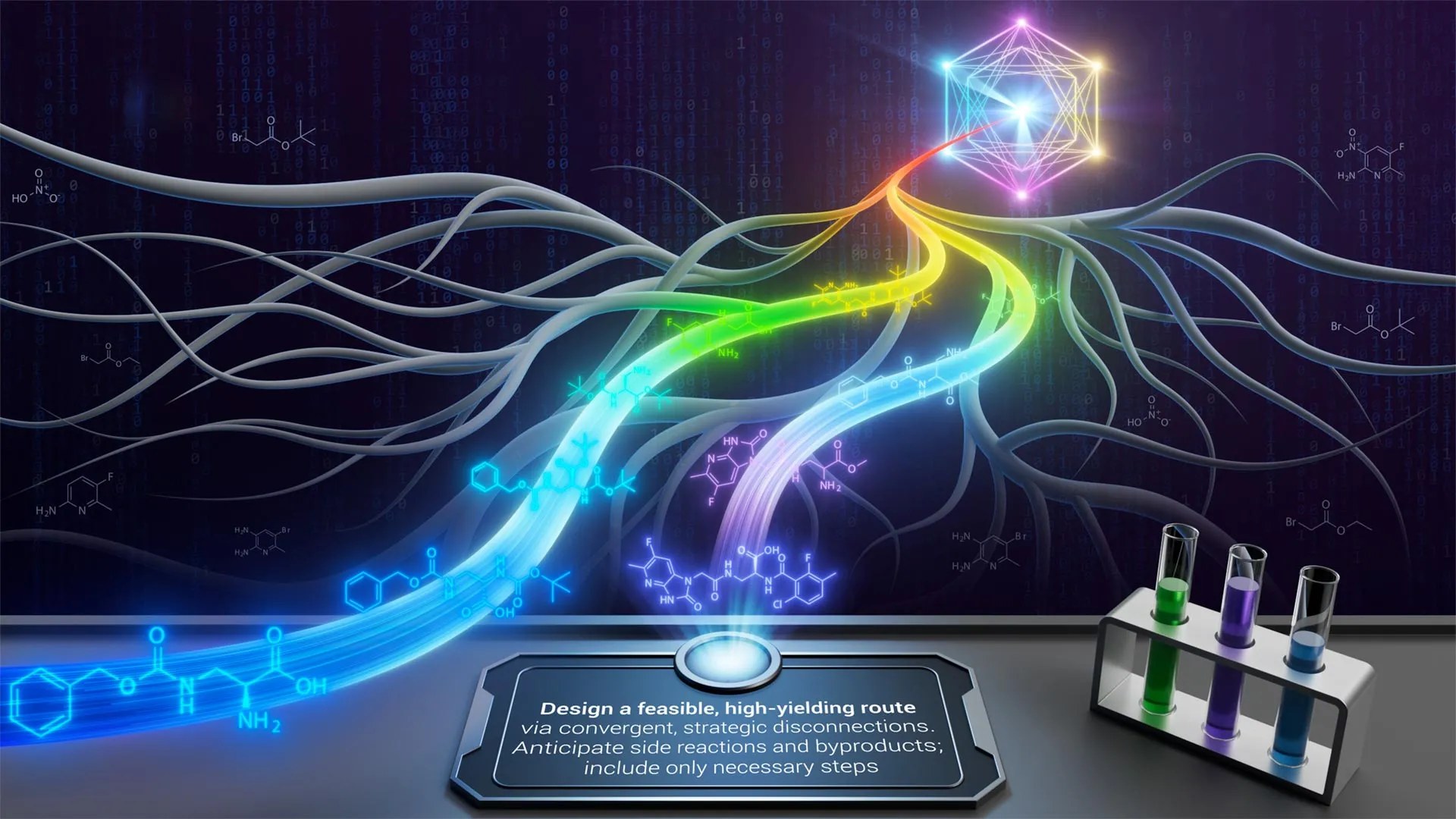
Synthegy doesn't try to reinvent the wheel or replace existing computational tools. It acts as an abstraction layer—an intelligent shell sitting atop traditional algorithms. The workflow is straightforward: a chemist defines a target molecule and adds specific requirements, such as forming a particular ring in the early stages or avoiding unnecessary protecting groups. As Andres M. Bran, lead author of the study published in Matter, explains, legacy tools with their clunky interfaces literally stifled the iteration process. Synthegy, however, converts potential reaction pathways into text that the LLM compares against the initial request. Ultimately, the AI evaluates strategies on the fly: determining if the electron-pushing sequence makes sense or if the expert's hypothesis is even feasible under the given conditions.
"With Synthegy, we are giving chemists the ability to just talk. This allows them to iterate through options faster and work with much more complex synthetic ideas," emphasizes Andres M. Bran.
In this setup, the AI evolves from a passive generator of options into an active reviewer. The system breaks reactions down into fundamental electronic interactions, filtering out theoretical noise and directing the search toward the most realistic scenarios. This is critical for understanding step-by-step reaction progress—a task where classic software often fails because it lacks the "gut feeling" required to pick the most efficient path among thousands of formally possible ones.
Validation and the Harsh Reality of the Lab Bench
For Big Pharma, this translates directly into savings on the endless trial-and-error cycles that typically drain budgets during drug discovery. Synthegy allows researchers to rank and filter synthesis routes before a lab technician even touches a flask. The transparency of the evaluation mechanism—the system explains why one path is superior to another—lowers the barrier of distrust among scientists. However, one shouldn't be misled: the gap between digital planning and physical execution remains. Synthegy is an excellent judge of "on-paper" feasibility, but it remains a navigator, not a replacement for human expertise. The final word still belongs to the reality of the lab bench, which AI cannot yet fully calculate.
Synthegy’s effectiveness proves that LLMs deliver the most value when serving as an interface for specialized algorithms rather than trying to replace them. High-level chemical logic still demands significant computational power, and the reliance on heavy models confirms this. The primary gain for the industry today lies in accelerating the "design-test" cycle, but the journey from a "described" molecule to a finished substance still hits the physical constraints of infrastructure—limitations that no amount of clever prompting can overcome.