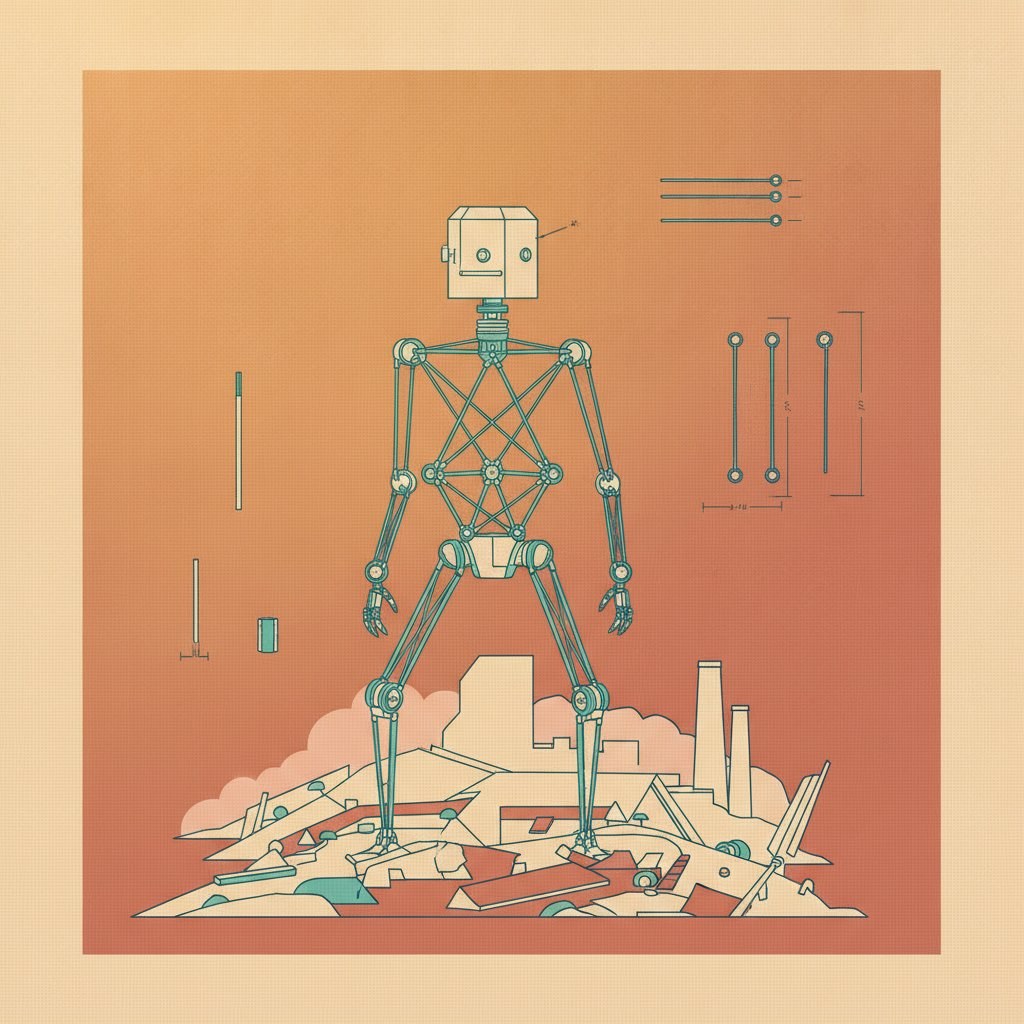
The structural fragility of autonomous agents has long been the primary bottleneck for deployment in high-risk environments. Traditional robotics relies on rigid chassis and complex damping systems to survive impacts—a design philosophy that prioritizes protection through mass, driving up both costs and failure rates. According to a study in Nature Machine Intelligence, researchers have developed Tribar, a three-bar tensegrity robot that bypasses these limitations through structural amortization. By suspending rigid struts within a network of elastic cables, the Tribar system maintains continuous tension and discontinuous compression. This isn't just an engineering curiosity; it’s an architecture that allows the robot to serve as its own landing gear, effectively stripping away the need for separate, heavy landers.
Mechanics of Structural Amortization
The Tribar design operates on the principle that rigid members should never touch, held instead in a delicate, resilient web. As the report by the research team (including lead authors from the University of California, Berkeley) detail, this configuration distributes impact forces across the entire network rather than concentrating stress on a single point of failure. In experimental stress tests, the Tribar robot survived high-impact drops from 5.7 meters. While a conventional rigid frame would have shattered under the resulting deceleration, Tribar’s structural resilience kept its electronics and actuators operational, proving that the frame itself is the ultimate shock absorber.
Tensegrity robots—composed of rigid struts suspended in a network of elastic cables—have been proposed as the next generation of planetary rovers and disaster response platforms.
By integrating sensing and power directly into this compliant frame, the Tribar prototype moves from a passive structural model to a functional autonomous agent. Testing involved repeated drops and a successful recovery after a fall from a cliff, demonstrating a level of durability that shifts the paradigm from 'protecting the robot' to 'building the robot as a protective shell.' Economically, this is a win for logistics: when the structure handles the impact, payload capacity for sensors and tools increases while the dead weight of parachutes and retrorockets vanishes.
Navigation Challenges and Deployment Constraints
However, durability comes with a tax on precision. Managing locomotion in a flexible robot requires sophisticated algorithms to handle variable cable tension and state estimation. Unlike a wheeled rover with fixed geometry, a tensegrity robot must change its shape to move, turning every step into a complex computational problem. The current prototype, while capable of autonomous navigation post-impact, lacks the positioning accuracy of traditional rigid-body systems. This trade-off between an 'unbreakable' frame and deterministic movement is the current technical frontier for the platform.
Despite these control hurdles, the potential for high-impact aerial deployment makes Tribar a candidate for monitoring disaster zones and deep mines where the risk to standard chassis is prohibitive. In environments where robots are often considered single-use due to terrain-induced trauma, Tribar’s survival metrics suggest a new path for rapid-response sensing. The custom control code, available via GitHub and Zenodo, provides the necessary baseline for engineers to manage these compliant structures in the field.
Ultimately, the Tribar architecture proves that structural intelligence can substitute for mechanical complexity, but the leap to commercial application depends on bridging the precision gap. While the elimination of landing modules offers a clear reduction in mission costs, the prototype remains a validation of impact resistance rather than a replacement for high-precision rovers. Tensegrity’s real-world utility will likely first materialize in 'sacrificial' first-in deployments—scenarios where the ability to survive the fall is the only metric that truly matters.