AI · This text was generated with artificial intelligence
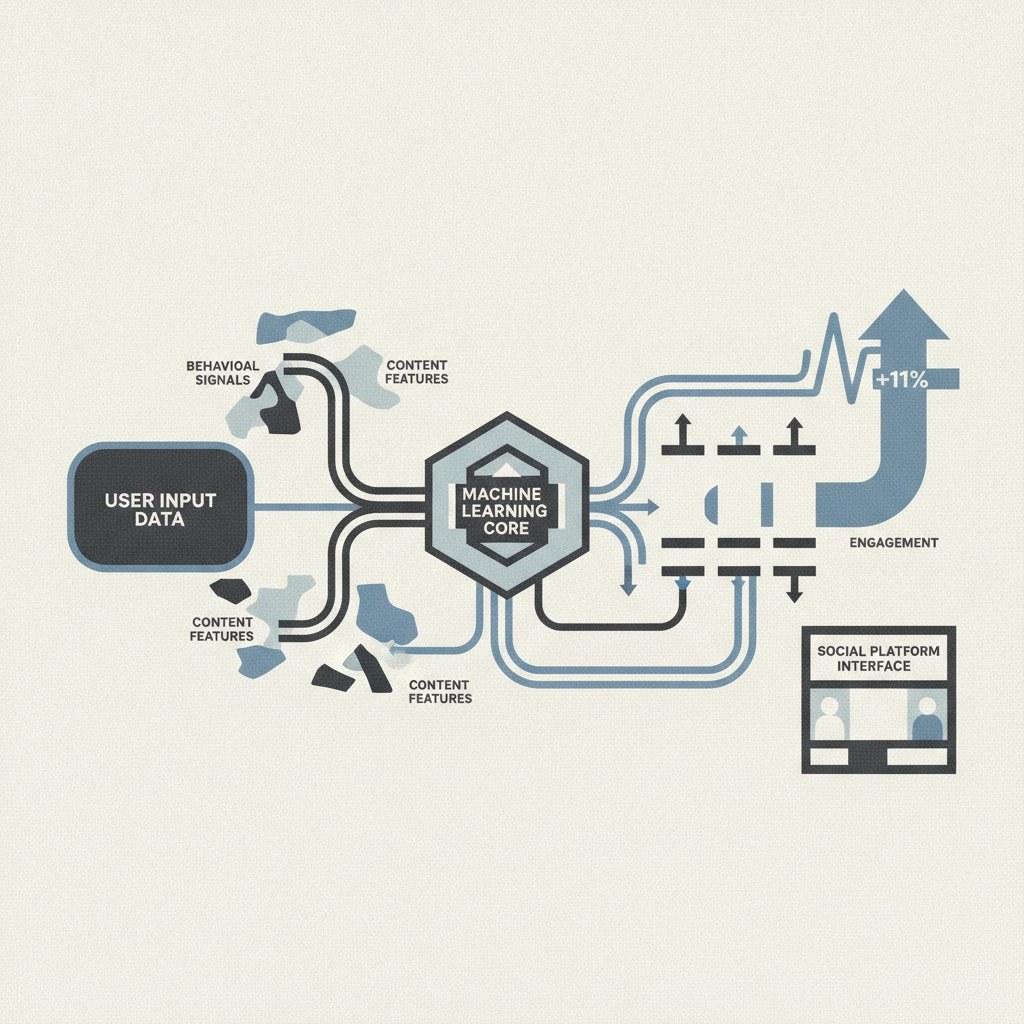
The battle for screen time in recommender systems hit a ceiling with basic topic matching long ago. Once a platform understands that a user likes cars or travel, unlocking further metric growth comes down to composing heterogeneous formats and filtering hidden noise out of the data. According to Stepan Malkevich, Head of Feed Recommendations at VK (AI VK), user time spent in the feed jumped by 11% over recent months in 2026—purely driven by re-engineering the ranker and blender pipelines.
A raster graphics algorithm inside the feed blender
The blender handles the final assembly of the feed, merging disparate content types into a unified stream. The VK team deployed ML models to calculate a personalized balance between short-form clips and standard text posts. Even when two users share the same topical interests, one might prefer long-reads while the other consumes video exclusively. The system computes a custom distribution ratio derived from each user's interaction history.
Previously, format sequencing relied on a stochastic algorithm that rolled the dice on each subsequent card using preset probabilities. Statistical variance consistently broke the layout balance over short screen sessions. To eliminate these skews, the engineering team replaced probabilistic sampling with Bresenham's line algorithm from classic computer graphics.
"It was originally invented for raster graphics to determine which pixels to fill so a diagonal line looks smooth on a grid."
Inside the feed, the algorithm serves the same purpose: it tracks format deficits step-by-step and allocates the next slot to the most lagging content type, guaranteeing tight layout geometry across every screen refresh.
Composite multi-target ranking and signal cleanup
The second optimization layer targeted the ranker, which dictates post ordering. The team transitioned the model from classic multi-target learning to a composite architecture: instead of independently summing isolated actions, the pipeline now computes a single, integrated engagement score.
Under this setup, user events are strictly categorized into three buckets: unambiguously positive (likes, follows, shares, bookmarks), unambiguously negative (hiding a post, reporting, unfollowing), and ambiguous (direct messages, community or profile clicks). Micro-actions like opening a photo or expanding text were completely removed from positive signals, as casual clicks frequently reward clickbait and distort the loss function. Dwell time now acts as a dynamic modifier: ultra-short views penalize the score like a skip, while sustained watch time boosts it. Contradictory behaviors—such as liking and hiding a post simultaneously—are excised from the training set to wipe out noise.
This case highlights the shift from monolithic recommendations to dynamic, multi-format orchestration. Unlocking retention gains no longer requires bloated models; it comes from rigorous mathematical distribution and uncompromising signal hygiene in the training pipeline.