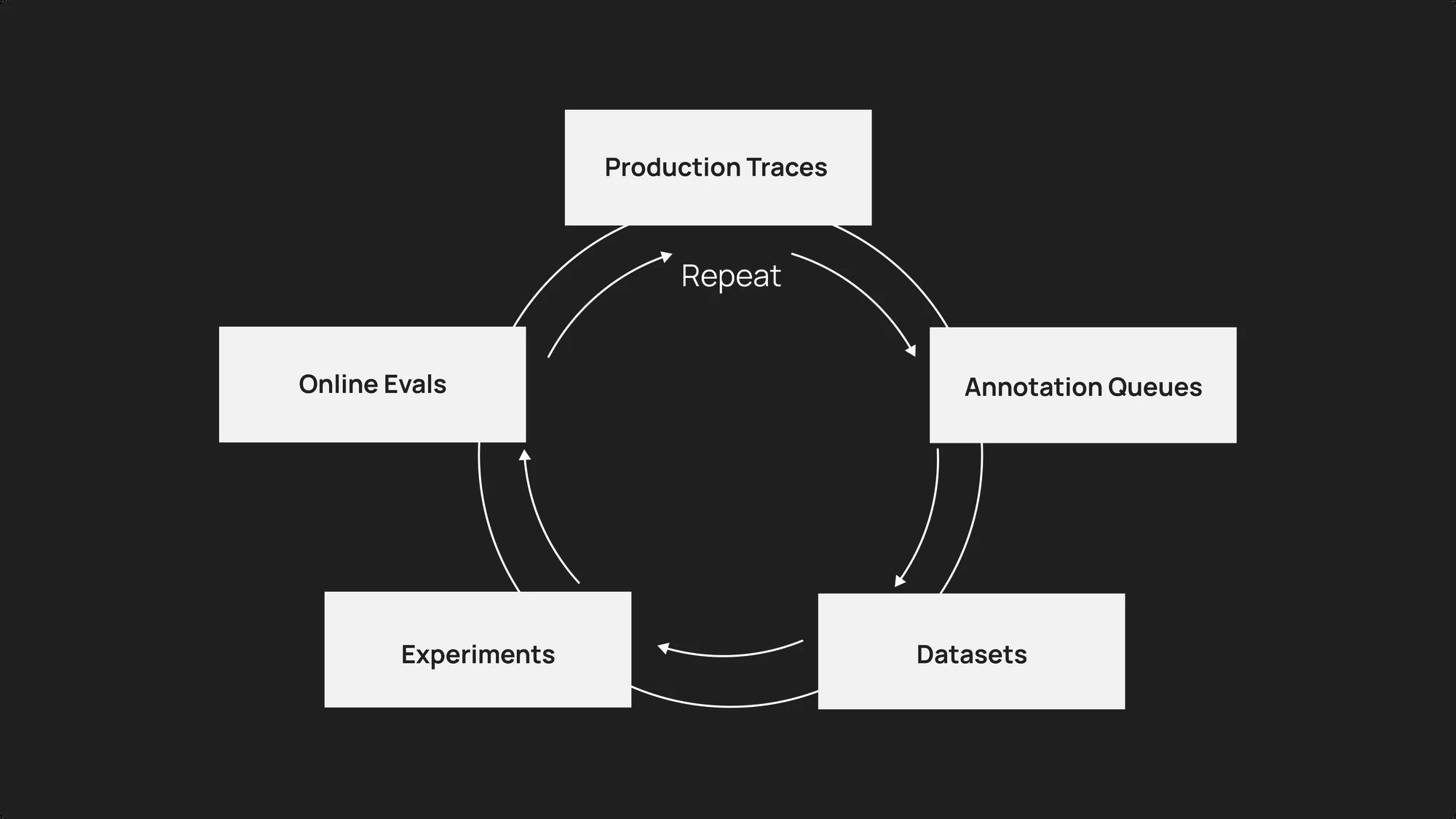
When enterprise engineering teams deploy standard web applications to production, operational expectations are straightforward. Systems rely on structured interfaces where users navigate predetermined paths, fill out typed forms, and execute deterministic logic. In these environments, robust automated test suites achieve 80–90% code coverage, while traditional Application Performance Monitoring (APM) suites track server metrics, latency, database query times, and HTTP status codes. When failure strikes, developers isolate the root cause through standardized error rates and stack traces.
Autonomous agent architectures dismantle these operational assumptions. As engineering teams shift workloads to LLM-powered pipelines, runtime behavior turns non-deterministic and the input space expands infinitely. Relying on legacy APM tools in this environment creates a dangerous illusion of control: a system can return clean HTTP 200 responses with nominal latency while hallucinating disastrously or burning through thousands of tokens in silent infinite loops. Runtime health now lives inside conversational semantics and execution trajectories, not infrastructure dashboards.
Unbounded Inputs and LLM Sensitivity
The fundamental friction of operating autonomous agents in production stems from the nature of natural language. Traditional software confines interaction to discrete UI components and strictly typed API contracts, allowing engineering teams to enumerate and handle edge cases before deployment. Agents, by contrast, ingest unstructured prompts that destroy the concept of bounded input space.
In a standard customer support workflow, a customer clicks through an order history view and triggers a predefined refund endpoint. With an agent, that exact intent arrives as a terse command, an informal multi-turn dialogue, or an ambiguous paragraph mixing three contradictory requests. Because the underlying model must dynamically infer intent and orchestrate tools on the fly, engineering teams cannot predict runtime paths through synthetic staging tests alone.
This sensitivity to minor phrasing shifts means an agent boasting clean benchmark scores in development can fail unpredictably when exposed to real traffic. Subtle changes in instruction ordering or context window formatting trigger probabilistic drift, steering the model toward incorrect tool selection or broken reasoning chains for identical underlying user requests.
Capturing Multi-Step Trajectories
Traditional APM suites track latency, traffic, error codes, and system saturation across deterministic microservices. Yet an agent can execute a flawless API call while delivering a fabricated answer or an unauthorized tool execution. Detecting semantic errors demands capturing the substance of the interaction rather than the transport metrics wrapped around it.
Engineering teams managing production agents must implement end-to-end trace collection across multi-step execution graphs. This requires logging complete prompt-response pairs, tracking intermediate scratchpads, monitoring context window degradation over multi-turn interactions, and recording external tool arguments alongside their payloads. Observability must also incorporate continuous production evaluations (evals-in-production) to catch semantic drift, enforce hallucination checks, and immediately terminate cyclic execution loops before compounding token costs drain infrastructure budgets.
Engineering leadership should audit existing production pipelines immediately: replace generic server-level health checks with semantic tracing layers that inspect intermediate reasoning paths and dynamic tool invocations, or accept that production failures will remain invisible until customers report them.