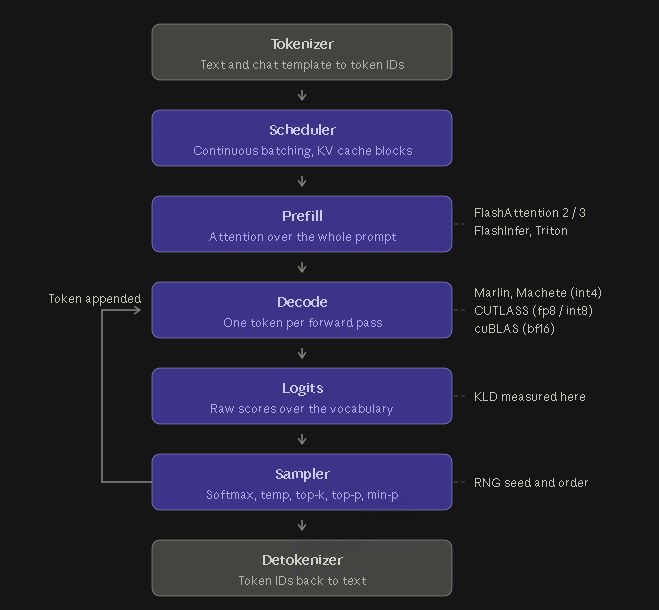
When enterprise engineering teams pull a fresh open-weight model from a public repository, operational reality promptly collides with published benchmark figures. Self-hosted deployments routinely degrade reasoning output, not because the underlying architecture is flawed, but because local execution environments diverge aggressively from first-party reference baselines. Blindly cutting compute overhead through uncalibrated quantization and runtime shortcuts creates downstream failures that wipe out infrastructure savings.
The Anatomy of Output Drift
Local hardware and inference runtimes rarely execute checkpoints under identical mathematical constraints. Mixing compute architectures introduces micro-architectural differences in floating-point operations, subtly warping logit generation across steps and driving sequence generation off course. Aggressive quantization schemes—especially extreme formats like 2.58-bit GGUF in convenience runtimes such as Ollama—severely truncate reasoning chains and cause token collapse long before a prompt resolves.
"Math is Math!"
Logits represent raw unnormalized scores for every candidate token before being shaped by samplers and decoded into text. When runtime configurations ignore official specifications—such as Hugging Face model cards mandating specific temperatures (e.g., 1.0) or top-p bounds (0.95)—and botch tokenizer chat templates, models like Qwen enter infinite reasoning loops inside thinking tags. Discrepancies in system prompt formatting and attention backends quietly invalidate lab-reported performance curves.
Measuring Runtime Divergence
Technical leaders cannot audit local inference health by running three zero-shot sanity prompts. Standard synthetic evals—including MMLU, SWE-bench, and HLE—must be executed against real-world, long-context tool-calling workflows to isolate where quantization formats and runtime dispatch layers compromise logic.
Closing the gap between repository leaderboards and internal production instances requires treated inference stacks as critical infrastructure. Teams must baseline every quantized checkpoint against first-party reference outputs across full context windows rather than trusting marketing benchmarks or assuming convenience runtimes preserve weight integrity.