AI · This text was generated with artificial intelligence
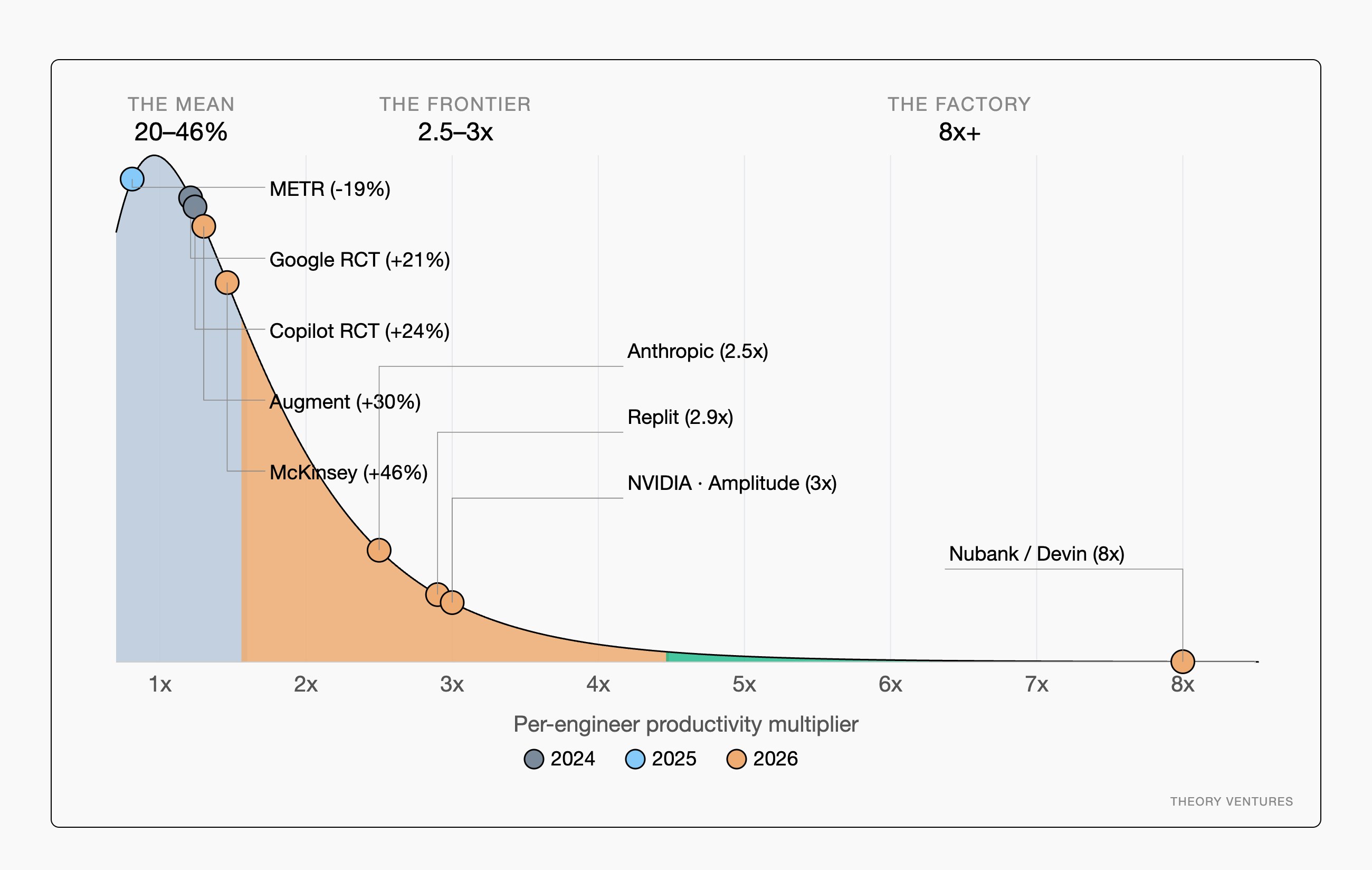
Engineering leaders entered the AI era dreaming of exponential productivity gains. However, harsh reality—documented by Augment Code—has capped those appetites at a modest 30%. This gap exposes a divide between companies using AI as a cosmetic fix and those rebuilding their operational core. Handing out AI IDE keys is the fastest way to start, but it has proven to be the most hopeless way to scale. Telemetry from Faros covering 22,000 developers revealed a sobering side effect of this shallow integration: while engineers close tasks 66% faster, the number of bugs per coder has jumped by 54%. The industry has hit a ceiling where simple automation yields only moderate gains at extreme risk.
From Assistants to Integrated Frontiers
The real shift is happening at the "frontier" level, where NVIDIA, Replit, and Amplitude have built a dedicated operational layer around agents. These organizations aren't just deploying chatbots; they are creating infrastructure that allows agents to seamlessly share context across GitHub, Linear, and Slack. NVIDIA reports a 3x increase in accepted commits across 30,000 employees, while the error curve remains flat. Amplitude has reached a point where an AI agent is now a top-3 contributor to the entire company codebase based on weekly commit volume.
Every employee gets an agent-manager that runs worker-agents in infinite loops. Our internal agent outperformed a seven-figure SaaS tool in security testing and incident triaging, costing us ten times less.
As Replit CEO Amjad Masad explained in his "Self-Driving Company" concept, this specific infrastructure allows for tripling per-engineer output without increasing incidents or rollbacks. At Anthropic, deploying Claude Code internally led to a 2.5x increase in code volume while maintaining stable quality. These wins aren't the result of picking the "smartest" model, but of creating an environment where agents can delegate complex decisions to humans while independently handling the bulk of execution.
The Software Factory Level
At the peak of this evolution sits the "factory" level, where agents become full-fledged staff members. Here, the focus shifts from assisting engineers to the mechanistic production of software. According to Contrary Research data from January 2026, Nubank achieved an eightfold efficiency improvement and a twentyfold cost reduction by using the Devin agent for large-scale refactoring. Goldman Sachs is already piloting a solution for 12,000 developers, expecting returns 3–4 times higher than previous-generation tools.
Market standards are shifting: a 3x output is the new baseline for every engineer. Companies stuck with 21–24% gains—figures cited in Google and GitHub benchmarks—are not just falling behind; they are incurring catastrophically high operational costs compared to leaders. AI promised to solve the talent shortage by making everyone more efficient. Instead, it has created a chasm where leaders produce eight times more while laggards drown in bugs generated by their primitive "assistants."