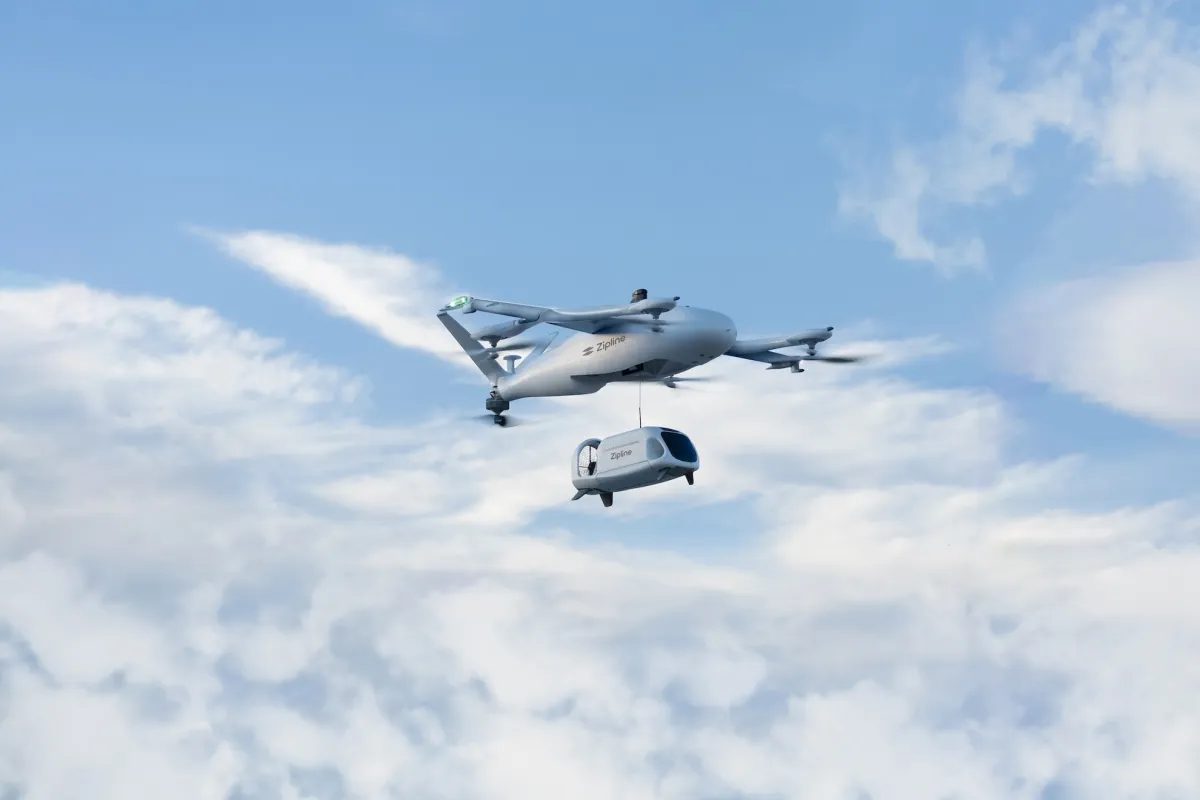
A $1.5 billion funding round at a $21.5 billion valuation, backed by Paradigm, WCM Investment Management, Layer Global, Valor Equity Partners, Fidelity Management & Research Company, Uber, Tiger Global, J.P. Morgan, ARK Invest, and Salesforce Ventures, marks a decisive shift for Zipline as corporate backers commit heavy capital directly to physical fulfillment rather than treating drone flights as experimental novelties.
The capital commitment raises a core operational question for corporate logistics: can automated delivery infrastructure sustain heavy physical expansion costs while preserving operating margins?
Zipline secured $1.5 billion in funding and expanded its Walmart partnership, pushing its valuation to $21.5 billion.
Institutional capital of this magnitude signals that autonomous supply chains are transitioning out of pilot tests and into core capital expense budgets.
The Walmart Hub Expansion
The real operational test centers on Zipline's commercial alliance with retail giant Walmart. According to the corporate announcement, the two companies reached a new multi-year agreement to add 300 drone delivery sites across the United States. While the retail partners have maintained an active agreement since 2021, the new footprint represents a steep escalation from the 21 active sites they operate together today.
This rapid physical scale-up follows broader retail shifts toward automated transactions. Coupling autonomous ordering with physical drone deployment creates a closed loop designed to bypass conventional parcel networks.
Shifting Delivery Unit Economics
The financial reality of last-mile drones faces severe hardware constraints and regulatory hurdles. Founded in 2014, California-based Zipline began operations in Africa by flying autonomous blood deliveries in Rwanda before expanding to Ghana and Nigeria, as documented in company operational histories.
Hardware specifications dictate the operational profile. Long-range routes rely on Platform 1 drones capable of covering 120 miles round trip for enterprise, business, and government clients. For suburban residential delivery, Zipline relies on Platform 2 drones that carry up to eight pounds within a tight 10-mile radius. That payload ceiling excludes heavy grocery orders, limiting flights to light consumer goods and prescriptions.
Zipline's share of delivery revenue grew from 10.8% to 34.9% between March and October of this year.
Scaling from 21 to 300 joint distribution sites with Walmart will determine whether dedicated manufacturing facilities can deliver sustainable unit costs across an automated network covering hundreds of metropolitan skies.
What it signals
An eight-pound payload limit on Platform 2 suburban drones keeps Zipline on the margins of Walmart's standard grocery basket. The hardware physically restricts operations to light consumer items and prescription medicines rather than full shopping runs.