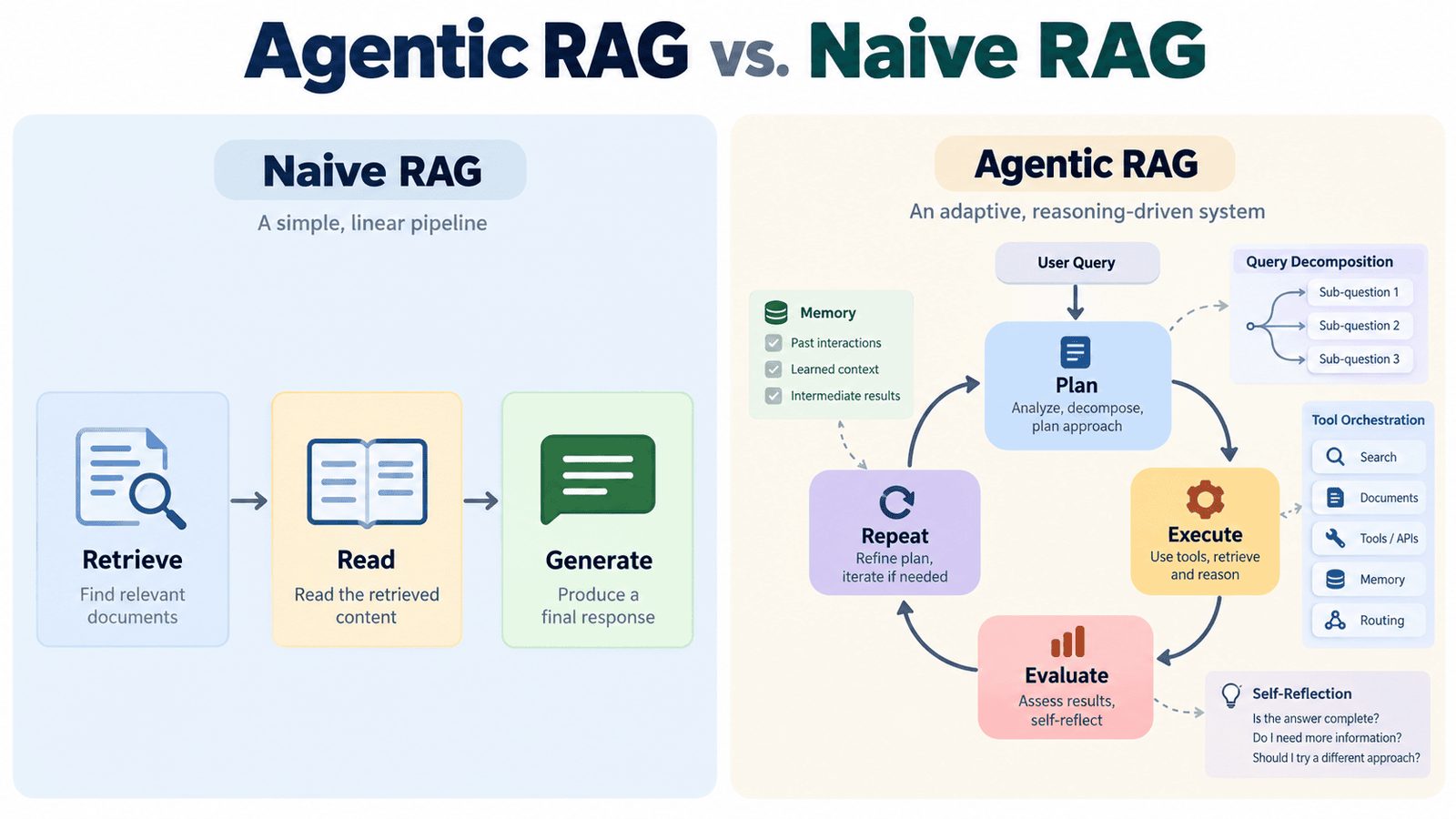
Standard RAG pipelines are linear — they retrieve once, pass those results to the model, and generate an answer. Large language models hallucinate by confidently producing plausible-sounding answers that are factually wrong without access to verified, up-to-date information. Retrieval-Augmented Generation grounds model outputs in external knowledge sources and reduces hallucinations across enterprise applications. Standard RAG pipelines are linear because they retrieve once, pass those results to the model, and generate an answer. When organizations push these systems into more complex workflows, a new problem surfaces.
The Architecture of Naive Retrieval
Naive RAG, also called standard RAG, follows a rigid three-stage pipeline consisting of Retrieve, Read, and Generate. A user submits a query, the system converts it into a vector embedding, and runs a similarity search against a vector database. When documents are ingested in Naive RAG, they are split into chunks and converted into dense vector representations using an embedding model. This was a genuine breakthrough, making it possible to build enterprise Q&A systems, internal knowledge assistants, and document summarizers that stayed grounded in verified sources.
The architecture's core weakness is its linearity where a single retrieval pass either succeeds or fails. In a multi-hop reasoning failure, a single vector search likely fails to bridge connections when information lives in separate documents. Enterprise environments reveal that multi-hop query failure rates soar when context is fragmented across siloed repositories, resulting in systemic gaps where the single-pass mechanism retrieves noise instead of signal. Answering complex queries requires multiple steps, but standard RAG gets one shot at retrieval, leaving the model to generate responses from incomplete or irrelevant context.
Moving to Autonomous Reasoning
Agentic RAG gives the system the ability to reason about how to search, evaluate what it finds, and iterate until it reaches a satisfying answer. Agentic RAG treats the large language model as an autonomous reasoning engine that actively orchestrates the entire retrieval process. Agentic RAG operates as a loop following the stages of Plan, Execute, Evaluate, and Repeat. Rather than treating retrieval as a single, fixed step, this architecture addresses the fundamental limits of linear data processing.
When evaluating the economics of inference costs versus human error losses, traditional single-pass pipelines shift the financial burden directly onto operational teams. While running multi-step agentic loops consumes more compute tokens and increases upfront inference expenditure, the alternative is absorbing the hidden costs of human correction, delayed decision-making, and catastrophic misinterpretations driven by single-pass failures. In high-stakes enterprise deployments, avoiding a single multi-hop query failure easily outweighs the marginal increase in computational overhead. As organizations scale their automation strategies, the math increasingly favors systems that verify their own work rather than forcing human operators to clean up the mess left behind by linear retrieval.