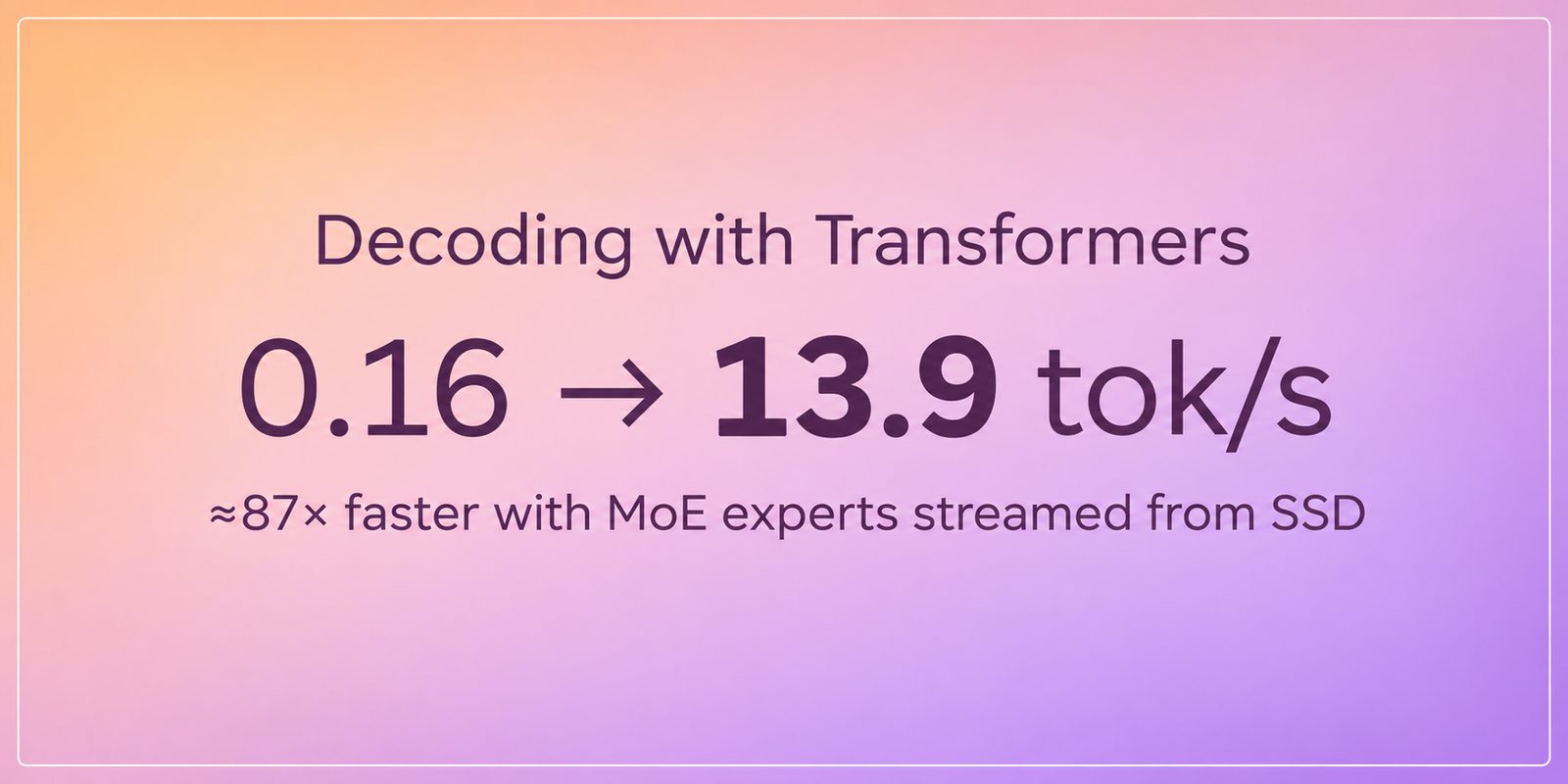
Capital expenditure on multi-GPU server clusters can be bypassed when massive sparse models stream their parameters straight from local solid-state storage. Technical findings from developer Tarek Ziadé show that streaming MoE experts directly from an SSD gets within 6% of Strata on token generation.
This benchmark fundamentally alters the unit economics of on-premises artificial intelligence. Relying on remote proprietary APIs creates recurring operational expenses and exposes data workflows to external platforms. Streaming weights of massive sparse models directly from local disk breaks the monopoly of enterprise datacentres over heavy architectures, moving private local inference into an accessible operational tier.
The viability of this framework depends on whether consumer storage buses can sustain adequate generation throughput without catastrophic latency degradation. When testing dense parameter footprints on smaller hardware, optimization projects have historically leaned on severe model compression. On 2026-08-22, a newly optimized NInfer inference build compressed the multimodal 143.84 GB Ornith-1.5-35B-A3B mixture-of-experts model down to a 21.22 GiB artifact. However, running full-scale sparse models without lossy compression requires an entirely different offloading pipeline.
The Offloading Bottlenecks in Existing Runtimes
Standard inference frameworks exhibit severe structural inefficiencies when executing sparse mixture-of-experts models on resource-constrained hardware. In a technical evaluation published on the HuggingFace Blog, Tarek Ziadé analyzed how existing engines allocate computation across memory tiers. The architectural mechanics reveal sharp contrasts: llama.cpp maps the GGUF file with mmap and can keep the experts on the CPU, ensuring weights never traverse the PCIe bus when activations move. Yet when experts exceed physical RAM, operating system page caches thrash, and its newer GPU expert cache introduces graph fragmentation that loses roughly 10% performance even when weights fit.
In contrast, vLLM routes weights through host memory channels with distinct performance trade-offs.
"vLLM's --cpu-offload-gb N puts N GB of weights in pinned RAM, and kernels read them in place over PCIe."
Because vLLM does not cache these routed weights, a frequently accessed expert must traverse the PCIe bus repeatedly on every single token. While restricting the transfer via parameters to offload only the experts doubles vLLM's speed, an alternative backend copying groups of layers ahead of time ran under 1 tok/s. Meanwhile, the standard Transformers library relies on Accelerate hooks to copy a layer's entire expert bank to the GPU before forward execution, moving all experts just to utilize eight or ten. How can an engine avoid moving entire expert banks across the bus without suffering catastrophic I/O bottlenecks?
Slot Pools and Bus Throughput
Direct routing solutions demonstrate that purpose-built memory architectures eliminate PCIe congestion. The specialized inference engine Strata manages models like Qwen by retaining only active hot experts in VRAM while offloading the rest to system RAM or physical disk. A prior benchmark observed Qwen3.8-Flash-Next running on a 32 GB Mac M4 at 13.5 tok/s under Strata. To recreate selective weight streaming natively within Hugging Face Transformers, Tarek Ziadé structured an implementation using OLMoE-1B-7B as an initial baseline.
An initial prototype relying on an on-device LRU cache and a serial Python loop registered 10.1 tok/s against 32 tok/s on vanilla Transformers. Performance bottlenecks stemmed from kernel orchestration rather than disk read speeds. Re-architecting the cache into a shared preallocated slot pool paired with a lookup table resolved the issue, raising execution speed to 34.6 tok/s against 38.1 tok/s for vanilla execution.
"Streaming MoE experts directly from SSD gets within 6% of Strata on token generation."
This architecture bypasses the operational bottleneck that previously degraded offloaded inference on consumer workstations. Tarek Ziadé implemented the full codebase using AI-assisted development across the Transformers pull request, model-specific packages, and Metal kernels, releasing the project artifacts in a Hugging Face Space named tarekziade/moe-expert-streaming. The standalone loader was subsequently submitted as an option of from_pretrained in huggingface/transformers#50717.
Hardware bounds dictate that SSD-based expert streaming cannot match the multi-user concurrency of dedicated datacenter clusters. Yet for dedicated single-tenant workloads, the architecture demonstrates that a standard local drive delivers sufficient bus throughput to run frontier-scale weights, establishing local sparse inference as an economically viable alternative to rented cloud capacity.
What it means
Swapping dedicated video memory for a standard solid-state drive looks like a performance dead end, yet the token generation speed lagged behind the dedicated Strata engine by less than 6%. Rather than ordering more server accelerators, the pipeline avoids pushing idle layers through the bus and uses cheap local storage instead. Rather than buying server racks, engineering simply squeezes usable token rates out of a solid-state drive.