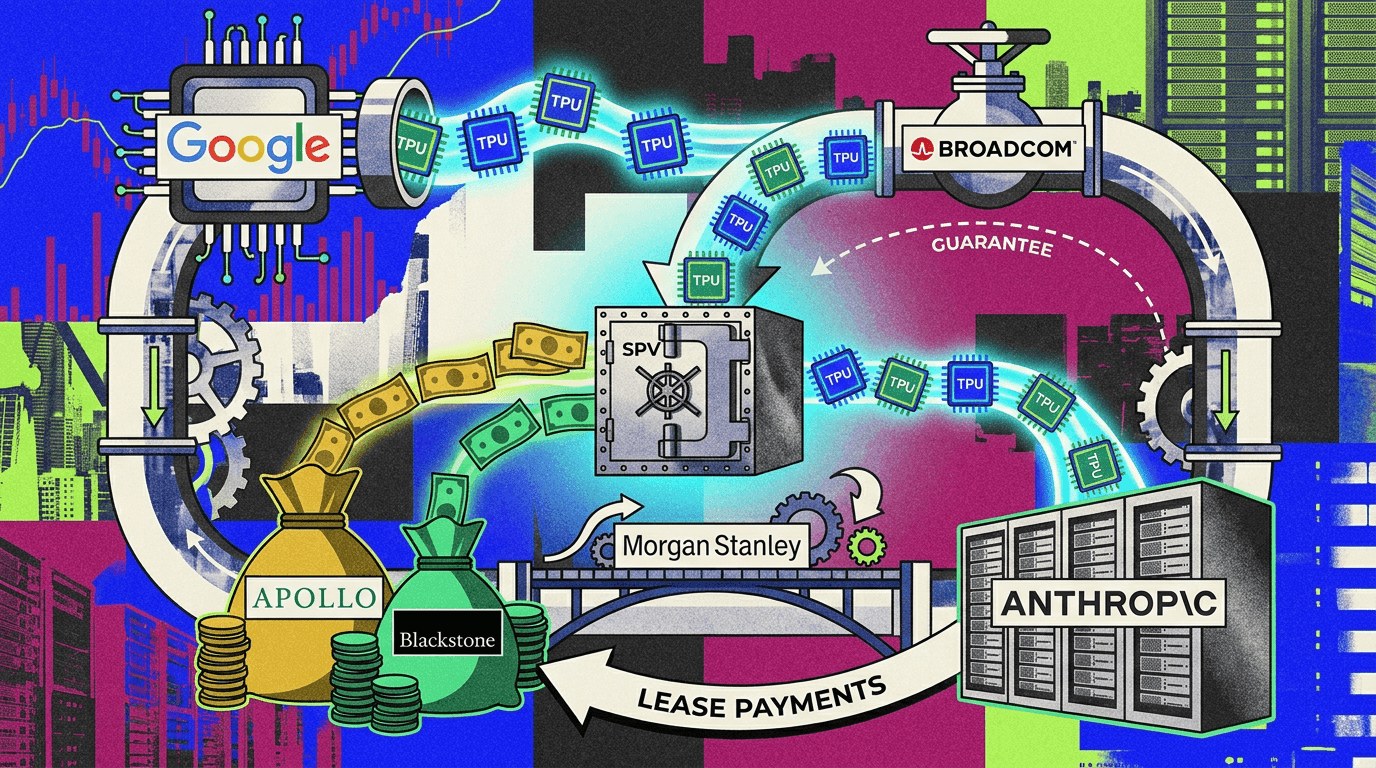
Google has orchestrated a sophisticated financial maneuver involving Broadcom and Morgan Stanley to equip Anthropic with $35 billion worth of Tensor Processing Units (TPUs) while keeping the massive liability off its own books. According to the Financial Times, the deal utilizes a special-purpose vehicle (SPV) dubbed 'Compute SPV' to acquire the chips using capital from external heavyweights like Apollo and Blackstone. In this setup, Broadcom acts as the guarantor for roughly $30 billion of the purchase, while Anthropic serves as the primary tenant, leasing the hardware to power its next-generation models.
This isn't just a procurement deal; it is a calculated effort to shield Google’s balance sheet from the brutal reality of hardware depreciation. By shifting the capital expenditure to an SPV, Google protects its quarterly reports from the drag of multi-billion-dollar infrastructure costs. To meet the physical demands of this expansion, Google is even sourcing power and data center capacity through unconventional partners like the crypto-mining firm TeraWulf, highlighting the desperate hunt for energy in the AI arms race.
The entire $200 billion architecture is a high-stakes bet on circular dependency. Google acts as both the lead investor in Anthropic and the sole provider of the proprietary infrastructure the startup is now subsidized to use. This creates a precarious feedback loop: the stability of Google’s massive cloud backlog now hinges entirely on Anthropic’s ability to monetize its AI faster than the underlying hardware becomes obsolete. If the startup's growth projections falter over the next five years, the entire off-balance-sheet house of cards risks a painful correction for all involved.