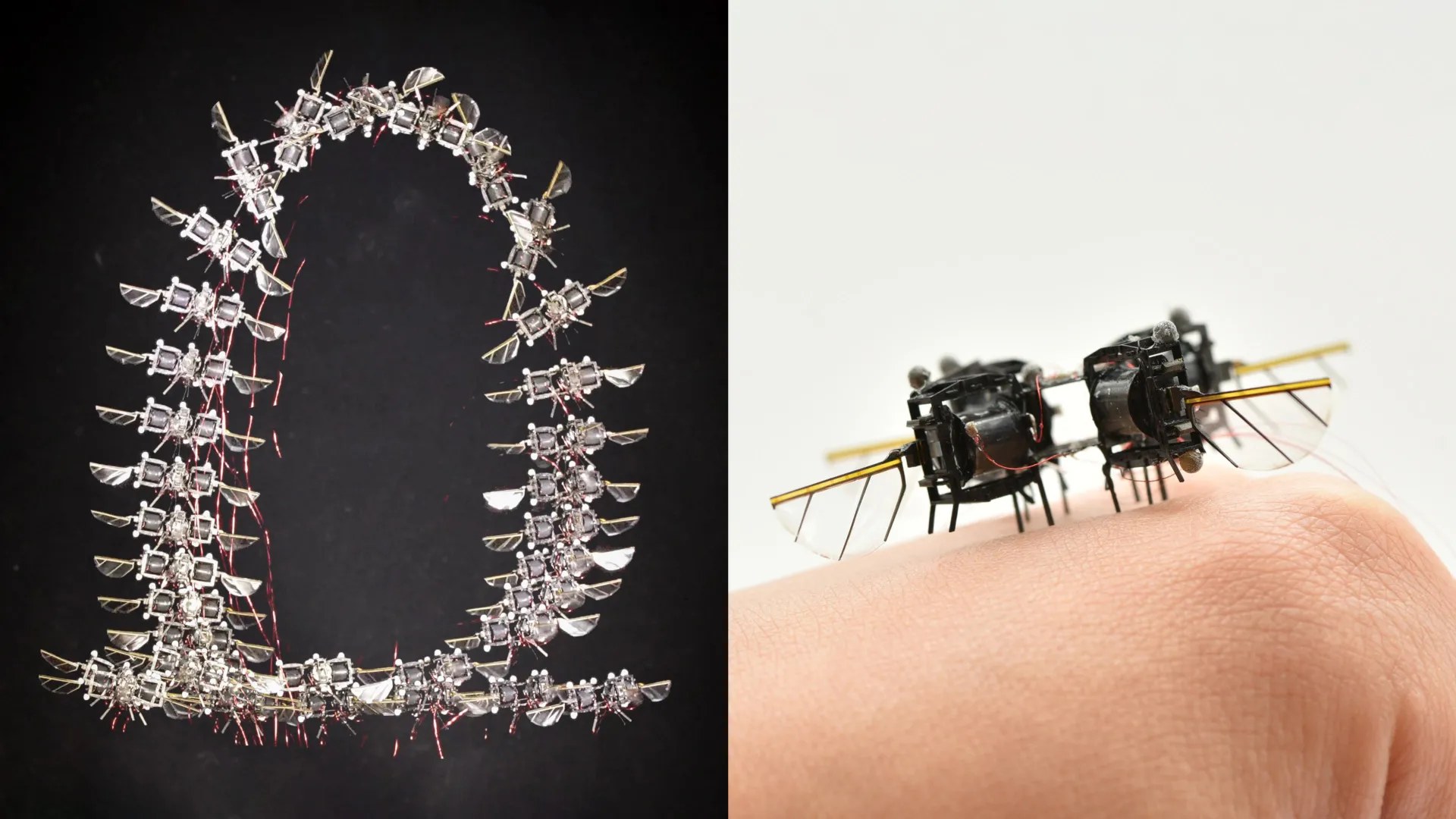
Aerial microrobots have historically lagged far behind biological insects in agility, moving at sluggish speeds along painfully basic trajectories. While these miniature platforms offer unique physical access to cramped spaces, the combination of complex aerodynamics and strict onboard compute limitations previously prevented them from executing any maneuvers more aggressive than a straight line.
Solving Microrobot Flight Dynamics
Researchers at the Massachusetts Institute of Technology have developed an AI-based control framework that finally enables an insect-scale flying robot to execute demanding acrobatics, including rapid turns and consecutive body flips. Published in Science Advances, the study details a two-part control system that increased the platform's flight speed by about 450 percent and boosted its acceleration by roughly 250 percent over earlier benchmarks.
Kevin Chen, an associate professor in the Department of Electrical Engineering and Computer Science and head of the Soft and Micro Robotics Laboratory, has spent more than five years developing robotic insects. This hardware iteration is roughly the size of a microcassette and weighs less than a paperclip. Its larger flapping wings are driven by soft artificial muscles that produce rapid wingbeats, requiring sophisticated real-time calculation just to stay airborne.
"We want to be able to use these robots in scenarios that more traditional quadcopter robots would have trouble flying into, but that insects could navigate. Now, with our bioinspired control framework, the flight performance of our robot is comparable to insects in terms of speed, acceleration, and the pitching angle. This is quite an exciting step toward that future goal," says Kevin Chen.
Jonathan P. How, the Ford Professor of Engineering in the Department of Aeronautics and Astronautics and a principal investigator in the Laboratory for Information and Decision Systems, partnered with Chen to crack this computational bottleneck. In earlier iterations, human engineers had to tune the controller by hand because full real-time aerodynamic calculations demanded far too much computing power for continuous operation.
Computational Efficiency in Tight Spaces
The team's solution is a split workload. The first part of the system relies on a model-predictive controller that uses a dynamic mathematical model to predict the robot's physical behavior and select the optimal sequence of actions for following a planned trajectory. During testing, the resulting platform completed 10 consecutive somersaults in 11 seconds while maintaining its path against active wind disturbances.
This is where the business case finally stops sounding like a lab daydream. The integration of dynamic model-predictive control provides the exact mathematical foundation needed for insect-scale drones to operate inside constrained industrial environments and hazardous disaster zones. While full field autonomy under real-world rubble conditions remains an ongoing engineering hurdle, moving miniature robotics to insect-grade speeds marks a genuinely measurable step toward inspecting closed spaces and collapsed structures that conventional quadcopters cannot even dream of entering.