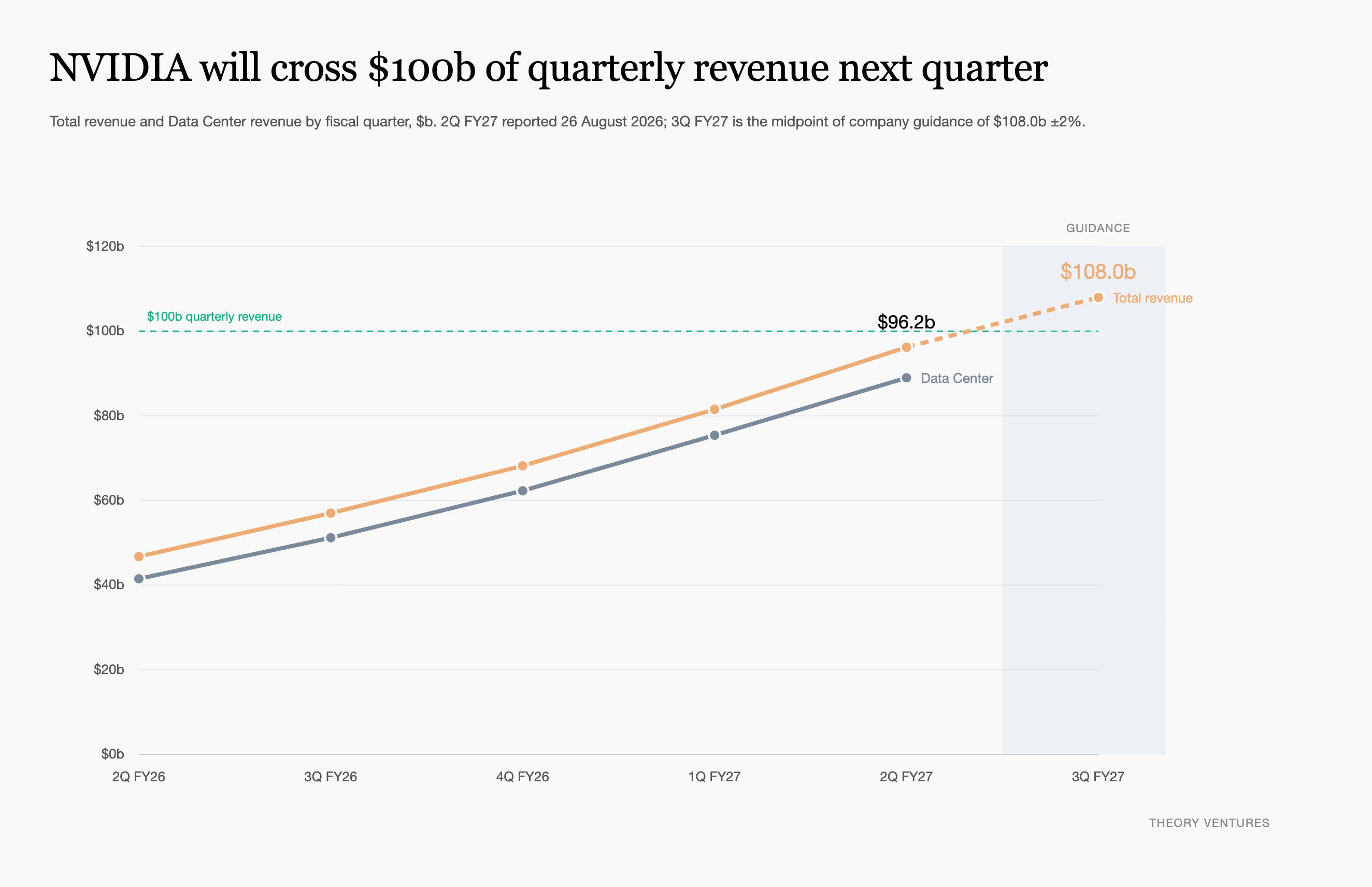
Nvidia posted $96 billion in revenue for the second quarter of fiscal 2027, representing a 106% jump from a year prior and an 18% sequential increase. With guidance set at $108 billion (±2%) for the third quarter, the chipmaker is set to cross the $100 billion quarterly threshold at a triple-digit growth rate. That annualized run-rate of $432 billion positions Nvidia as the sixth largest company globally by revenue, trailing only Amazon, Walmart, State Grid, UnitedHealth, and Saudi Aramco. Operating at a 75.0% gross margin, this trajectory translates to $324 billion in annual gross profit.
Beneath the headline top-line expansion, the customer distribution reveals a structural realignment. While hyperscaler revenue expanded 13% sequentially, the enterprise and alternative compute market grew at nearly double that pace. As CFO Colette Kress outlined during the earnings review:
"Hyperscale revenue more than doubled from a year ago and increased 13% sequentially… ACIE revenue increased 138% from a year ago and 25% sequentially driven by end-demand from AI natives, enterprises, and sovereign customers."
This shift marked the first period where neoclouds generated the majority of net-new Data Center revenue. The hyperscaler deceleration coincides directly with Big Tech scaling in-house custom silicon, including Google TPUs, Amazon Trainium, and Meta MTIA. CEO Jensen Huang framed this widening footprint around emerging demand channels, arguing that while a single frontier lab anchored compute buildouts a year ago, sustained hardware consumption now leans on parallel foundation model scaling, open-source development, and physical AI buildouts.
Vendor Financing and the $581B Obligation Stack
Selling outside deep-pocketed Big Tech introduces direct balance-sheet vulnerability: startups and neocloud operators lack the balance sheet depth of traditional hyperscalers. To sustain volume across tier-two buyers, Nvidia is effectively shouldering customer credit risk. Over a single quarter, Days Sales Outstanding (DSO) jumped from 45 to 60 days, breaking an eight-quarter run where the metric hovered predictably between 43 and 46 days. While top-line revenue grew 18% quarter-over-quarter, accounts receivable spiked 64% to $63 billion.
Kress attributed the receivable surge to extended payment terms on large, multi-quarter agreements with investment-grade clients. However, the vendor's total systemic exposure goes far beyond extended invoice terms. Nvidia has constructed a $581 billion stack of supply commitments, power reservations, and infrastructure lease obligations, backed by $101 billion in direct equity stakes across the very AI startups and neocloud providers procuring its accelerators.
Watching whether DSO stabilizes at 60 days or deteriorates further in the coming quarters offers enterprise buyers and infrastructure operators the clearest leading metric on secondary-cloud solvency and actual underlying hardware pricing power.