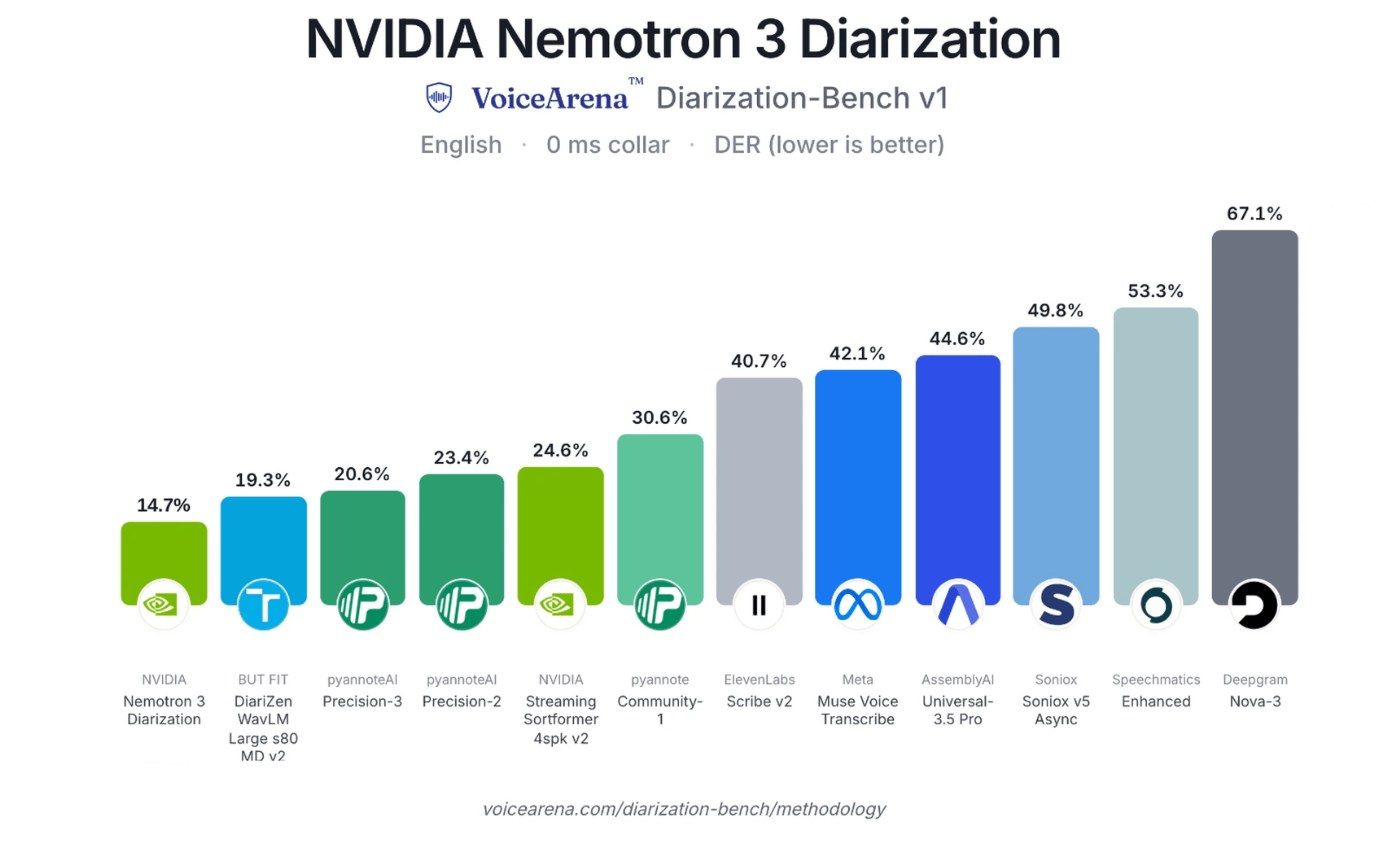
Nvidia has released Nemotron 3 Diarization, a compact 100-million parameter model designed to track and separate up to eight simultaneous speakers in real time. For companies burning budget on third-party cloud APIs to parse customer service calls, this local-first release offers a pragmatic way to trim overhead.
Benchmark Lead and Architecture
On the Diarization-Bench from VoiceArena, Nemotron 3 Diarization claimed the top spot with a 14.72 percent error rate, beating the runner-up at 19.3 percent. The benchmark applies strict evaluation criteria where overlapping speech and minor misalignments at transition boundaries count against the system. When measured against its predecessor, Streaming Sortformer, across eight test scenarios using a 1.04-second buffer, the architecture cuts the error rate by an average of 41 percent.
Latency Controls and Operational Limits
The system supports separating up to eight distinct speakers simultaneously and includes explicit detection for instances where several participants talk at the same time.
Paired with a speech recognition system like Parakeet, the model can produce transcripts with speaker labels, though only anonymous ones like "speaker_2."
Engineers can configure audio processing through four buffer presets, spanning from 30.4 seconds down to 0.32 seconds. Accuracy degrades when operating under shorter buffer configurations, and the model exhibits higher error rates in conditions characterized by heavy background noise, acoustic reverberation, or larger numbers of conversational participants.
Deploying a 100-million parameter model locally changes the unit economics for operations drowning in audio data. While background noise and aggressive buffer reduction will still trip it up, bypassing per-minute cloud API fees makes this kind of local inference an easy win for technical leads.